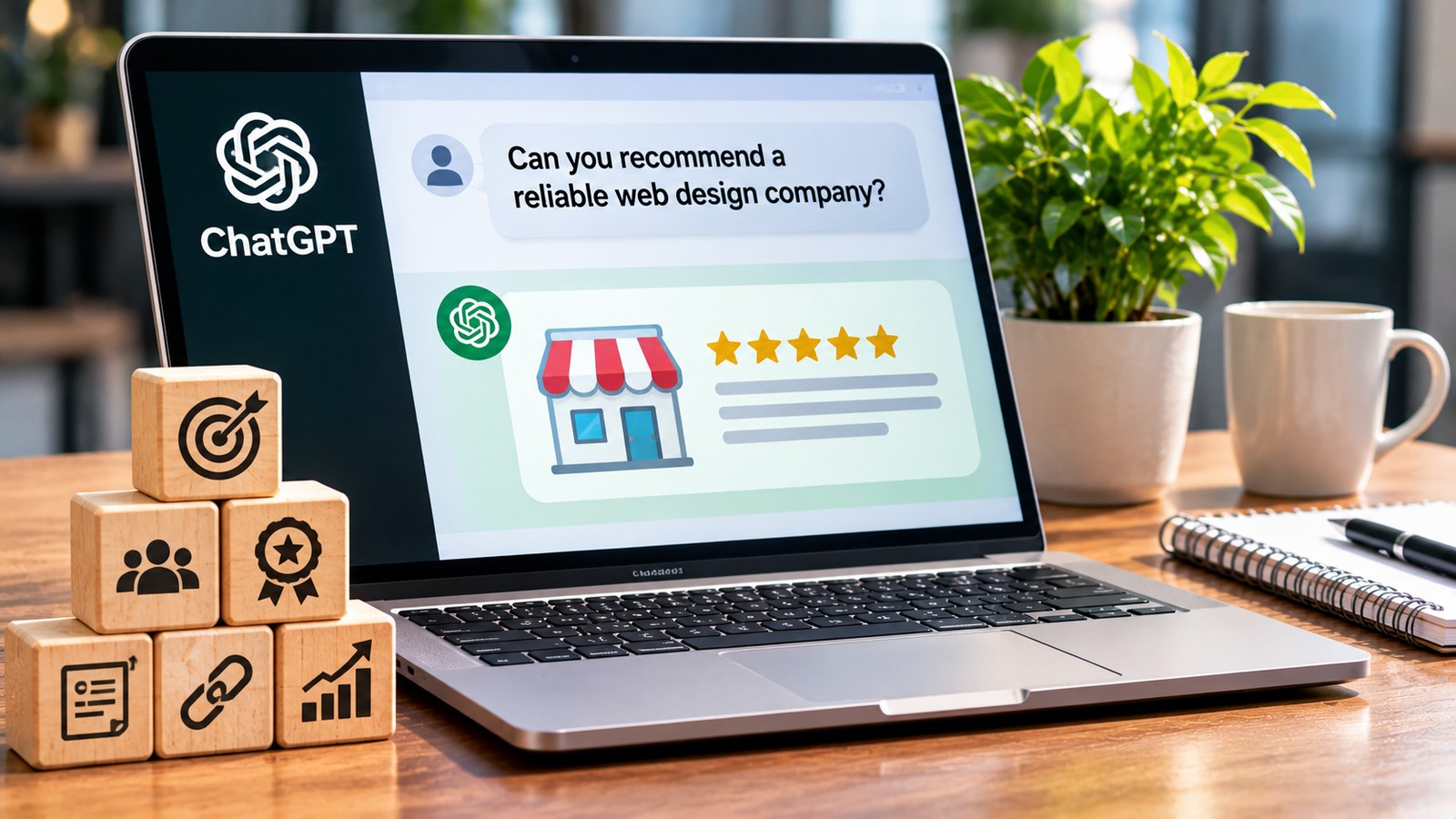
Imagine a potential customer asking ChatGPT to recommend a reliable PR agency, compare digital marketing companies, find a software provider, or identify the best service for a particular business need. Your company could be one of the options discussed, but only if the information available to AI systems makes your business relevant to that question.
This is changing how companies approach online visibility. Traditional digital marketing often focuses on appearing in Google search results. Today, businesses also want to become visible in AI-powered platforms where people ask questions, explore alternatives, compare providers, and make purchasing decisions.
Getting recommended by ChatGPT is not as simple as adding keywords to a website or publishing a few articles. It requires a broader approach that combines useful website content, consistent business information, industry recognition, customer feedback, and technical accessibility.
This guide explains how ChatGPT discovers business information, what companies can do to improve their chances of being mentioned, and how to build an online presence that supports AI-driven business discovery.
How Does ChatGPT Recommend Businesses?
ChatGPT can answer business-related questions using its existing knowledge and, when appropriate, information retrieved through web search. When someone asks for a recommendation that depends on current information, ChatGPT may search the web, examine relevant pages, and use information from those sources to prepare an answer.
For example, a user might ask:
- Which are the best PR distribution companies for crypto businesses?
- Recommend a reliable online reputation management agency.
- What are some affordable digital marketing companies for startups?
- Which software providers offer good customer support?
- Compare companies offering press release distribution services.
Depending on the question, ChatGPT may provide a list of businesses, explain the differences between providers, identify relevant services, or include links to useful websites.
There is no fixed public formula that guarantees a company will be recommended. ChatGPT search uses multiple factors to identify relevant and reliable information, and placement is not guaranteed.
This means businesses should focus on building genuine relevance and credibility rather than trying to manipulate a supposed AI ranking system.
1. Make Your Business Website Easy for ChatGPT to Discover
Your website is one of the most important places where AI systems can learn about your company. If your pages are inaccessible, unclear, outdated, or missing important information, it becomes harder for external systems to understand your business accurately.
Start by checking whether your website allows OpenAI’s search crawler, OAI-SearchBot, to access its public pages.
OpenAI identifies OAI-SearchBot as the crawler used to surface websites in ChatGPT search results. If a website opts out of this crawler, its pages will not be shown in ChatGPT search answers, although navigational links may still appear.
Ask your developer or website administrator to review your robots.txt file and confirm that your hosting provider, firewall, and content delivery network are not blocking the crawler.
A basic robots.txt configuration that allows the crawler can look like this:
User-agent: OAI-SearchBot
Allow: /
This is an example, not a complete robots.txt file for every website. Existing rules should be reviewed before making changes.
It is also important to understand the difference between OpenAI’s crawlers:
- OAI-SearchBot: Used to discover and surface websites in ChatGPT search.
- GPTBot: Used to crawl content that may be used to improve OpenAI’s foundation models.
- ChatGPT-User: Used for certain user-initiated requests to visit web pages. It is not the crawler used to determine automatic search inclusion.
These settings are independent. A business can allow OAI-SearchBot while disallowing GPTBot if it wants to support ChatGPT search discovery without allowing content to be crawled by GPTBot for potential model training.
2. Create a Clear and Detailed Business Website
AI systems need to understand what a company actually does. A website that only contains broad marketing statements may not provide enough useful information to distinguish one business from another.
Instead of describing your company as simply a leading digital solutions provider, explain the services, industries, customers, and problems your business addresses.
For example, a press release distribution company should clearly explain:
- What type of press release distribution it offers.
- Whether it supports technology, finance, crypto, healthcare, or other industries.
- What distribution options are available.
- Which types of businesses can use its services.
- How its publishing and editorial processes work.
- What customers should understand before purchasing a package.
This information gives readers and search systems a more complete understanding of the business.
Important pages to maintain include:
About Us
Explain when the company was established, what it does, which markets it serves, and what makes its services relevant. Avoid unsupported claims about being the world’s leading or number one provider.
Services
Create detailed pages for each major service. Explain the process, deliverables, intended customers, limitations, and expected outcomes.
Pricing
If pricing is public, keep it accurate and easy to understand. Explain what is included in each package and identify any additional costs or conditions.
Contact Information
Provide accurate business contact details, company information, and appropriate ways for potential customers to reach you.
Frequently Asked Questions
Answer genuine questions about your services. Clear explanations can help both customers and AI systems understand what your business offers.
3. Publish Content That Answers Real Customer Questions
One of the most practical ways to improve your visibility in AI-powered search is to publish useful information that matches the questions customers ask.
Think beyond conventional company updates and promotional articles. Build a content library that helps people understand an industry, compare solutions, evaluate providers, and make informed decisions.
For example, a company offering online reputation management could publish articles about:
- How online reputation management works.
- How businesses can respond to negative reviews.
- What to look for when choosing an ORM agency.
- How reputation management differs from public relations.
- How to monitor a brand’s online presence.
- What businesses should know before purchasing review management services.
A crypto press release company could develop content around:
- How crypto press release distribution works.
- What makes a cryptocurrency announcement newsworthy.
- How to choose a crypto media distribution provider.
- What businesses should expect from a press release campaign.
- Differences between press release distribution and sponsored articles.
These topics are valuable because they address specific information needs instead of repeatedly promoting a company’s services.
Build Content Around Different Stages of Customer Research
People do not always begin their research by searching for a company name. They may first investigate a problem, explore available solutions, and then compare providers.
A strong content strategy should cover all three stages.
- Informational content: Explains problems, concepts, processes, and industry developments.
- Comparison content: Helps readers evaluate different services, approaches, and providers.
- Commercial content: Explains the company’s services, pricing, capabilities, and suitability.
This creates a useful information ecosystem around your business and its industry.
4. Build Brand Mentions Across Relevant Websites
Your company website is not the only place where people can learn about your business. Industry publications, business directories, editorial websites, professional communities, and relevant third-party platforms can also contribute to your online presence.
When a company is mentioned across credible and relevant sources, customers have more opportunities to discover it and verify its identity.
For example, a software company may build its industry presence through:
- Technology publication coverage.
- Independent product reviews.
- Relevant business directory profiles.
- Industry interviews.
- Professional community discussions.
- Useful research and educational contributions.
The objective should be meaningful brand recognition, not simply increasing the number of websites containing your company name.
Publishing hundreds of low-quality articles with identical promotional descriptions does not establish genuine credibility. A smaller number of relevant, informative mentions can provide a stronger foundation.
5. Get Your Business Covered by Industry Publications
Public relations can help businesses build visibility beyond their own websites. When a company has a genuine announcement, useful research, an industry perspective, or a meaningful business development, relevant media coverage can introduce its brand to new audiences.
Consider the type of information an industry publication might find useful:
- A significant company launch or expansion.
- A new product or service with clear market relevance.
- Original research or industry findings.
- Expert commentary on an important development.
- A business milestone supported by verifiable information.
- A useful analysis of changing customer or industry trends.
Press releases can help distribute company announcements, but distribution alone does not guarantee independent editorial coverage or an AI recommendation.
Focus on creating announcements that provide real information. Avoid treating every press release as an opportunity to repeat promotional claims.
6. Maintain Consistent Business Information Everywhere
Inconsistent business information can make it harder for customers to understand whether different online profiles refer to the same company.
For example, a business might use one company name on its website, a slightly different name in a directory, and an outdated description on a professional profile.
Review the major places where your company appears and keep the following information consistent:
- Official business name.
- Website domain.
- Primary business category.
- Company description.
- Location and service areas, where relevant.
- Contact details.
- Founding information, where publicly stated.
- Main services and product categories.
Consistency does not mean copying the same description everywhere. Each platform can have its own format, but the essential facts about the business should remain accurate.
7. Build Genuine Customer Reviews and Reputation
Customer feedback is an important part of how people evaluate businesses. Before selecting a service provider, customers often look for reviews, experiences, ratings, and information about how a company handles problems.
A business with a transparent and well-maintained review presence gives potential customers more information to consider.
To develop a credible review profile:
- Invite genuine customers to share honest feedback.
- Make it easy for customers to leave reviews on relevant platforms.
- Respond professionally to both positive and negative experiences.
- Address recurring complaints instead of ignoring them.
- Avoid purchasing fake reviews or creating misleading testimonials.
- Keep testimonials accurate and obtain permission before publishing them.
Reviews should not be treated as a guaranteed way to influence ChatGPT recommendations. Their main value is providing authentic information that helps people assess a company’s reliability and customer experience.
8. Publish Detailed Comparison and Alternative Pages
People frequently use AI assistants to compare businesses before making a decision. They may ask for alternatives to a particular service, compare pricing, or identify providers that specialise in a particular industry.
Companies can support this research by publishing genuinely useful comparison content.
For example, a software company might create articles covering:
- Different types of project management software.
- Features to compare before choosing a platform.
- Software options for small businesses.
- Cloud-based tools versus traditional software.
A PR agency might explain the differences between media relations, press release distribution, sponsored content, and traditional public relations.
When comparing competitors, present accurate information and explain the criteria used. Do not invent disadvantages, publish misleading comparisons, or present unsupported claims as facts.
Useful comparison content helps customers understand the market, even when your company is not the right option for every reader.
9. Use Structured Data to Explain Your Business
Structured data is a way of describing information on a website in a format that search engines and other systems can interpret more consistently.
Depending on the business, relevant schema types may include:
- Organization: Describes a company or organization.
- LocalBusiness: Describes a local business and its relevant details.
- Product: Describes products and their attributes.
- Service: Can describe services offered by a business.
- Article: Describes published editorial content.
- Person: Describes an individual, such as an author or company representative.
For example, Organization structured data can help identify a company’s official name, website, logo, and other supported details.
Structured data should accurately reflect information visible on the website. Adding schema does not guarantee that ChatGPT will recommend your business, but it can make certain information easier for supported systems to interpret.
10. Make Your Website Useful for AI Search
Technical accessibility is only one part of the process. Your website should also present information in a way that makes it easy to understand.
Consider the following improvements:
Use Descriptive Page Titles
Give each important page a title that explains its subject. Avoid vague headings that do not communicate what the page contains.
Organise Content with Clear Headings
Use logical H2 and H3 headings to separate topics. This helps visitors navigate long articles and makes the information easier to interpret.
Explain Industry Terms
Do not assume every visitor understands specialised terminology. Define important concepts and explain how they relate to your services.
Keep Information Updated
Review outdated service descriptions, pricing, product information, staff details, and company announcements. Remove or correct information that is no longer accurate.
Make Important Pages Accessible
Ensure that essential business information is available in readable page content rather than being hidden entirely behind images, inaccessible scripts, or complicated interactive elements.
Improve Website Performance
Make sure pages load reliably, work on mobile devices, and provide a straightforward browsing experience. Check for broken pages, redirect problems, and server errors.
11. Use OpenAI Business Hub to Manage Your Business Presence
Businesses now have another important opportunity to manage how they appear in ChatGPT.
On November 10, 2026, OpenAI announced Businesses in ChatGPT in beta, introducing Business Hub as a way for eligible businesses to claim their company, manage business information, and understand how people engage with them through ChatGPT.
According to the announcement, verified businesses can update key details and add self-service product feeds containing pricing and availability.
Business Hub also provides aggregated insights, including business mentions, website clicks, and discovery topics. These insights can help companies understand the subjects and conversations in which their websites are being cited.
Businesses should investigate eligibility and availability through the official Business Hub experience. The announcement also describes Business Agents, which allow eligible organisations to build experiences that help customers explore their offerings. Initial Business Agent availability is limited to eligible ecommerce and online service businesses in the United States.
This is an important development because it gives eligible businesses a more direct way to manage certain information presented through ChatGPT rather than relying entirely on external websites.
12. Monitor Whether ChatGPT Mentions Your Business
Improving visibility without measuring the results makes it difficult to understand what is working. Businesses should regularly check how AI assistants describe their company and whether they appear in relevant recommendation conversations.
Create a list of questions that potential customers might ask ChatGPT.
For example:
- Which companies offer press release distribution for cryptocurrency businesses?
- What are the best online reputation management agencies?
- Recommend digital marketing companies for small businesses.
- Which platforms offer affordable PR distribution services?
- What are some alternatives to a particular software provider?
- Which companies specialise in brand reputation management?
Test these questions periodically and record the results.
Pay attention to more than whether your company appears. Check whether the description is accurate, whether the correct website is cited, which competing businesses are mentioned, and what information appears to influence the comparison.
Repeat tests using different wording and relevant locations. ChatGPT responses can vary based on the question, available search information, and context, so one result should not be treated as a permanent ranking.
Measure More Than Brand Mentions
A useful AI visibility report can include:
- Number of relevant prompts in which the business appears.
- Accuracy of the company’s description.
- Website citations and referral visits.
- Competitor mentions in the same conversations.
- Pages that are cited most frequently.
- Customer enquiries that mention discovering the business through AI.
Businesses with access to Business Hub can also use its aggregated engagement insights where available.
13. Avoid Shortcuts That Can Damage Your Business Reputation
As interest in AI recommendations increases, some businesses may be tempted to use shortcuts to create the appearance of popularity or authority.
These approaches can produce misleading information and damage customer trust.
Avoid:
- Publishing fake customer reviews.
- Creating fabricated case studies or business achievements.
- Producing large volumes of repetitive, low-value articles.
- Paying for misleading editorial coverage.
- Publishing unsupported claims about being the best or most trusted provider.
- Creating fake company profiles across multiple websites.
- Using automated spam discussions to promote a business.
AI visibility should be built around information that customers can verify. A credible online presence is more valuable over time than a temporary increase in brand mentions.
A Practical 90-Day Plan to Improve ChatGPT Business Visibility
Businesses that want to improve their AI visibility can begin with a structured three-month programme. The following plan provides a practical starting point.
Days 1 to 30: Fix the Foundations
- Audit your website and important business pages.
- Check OAI-SearchBot access and relevant security restrictions.
- Update your company description and service information.
- Correct inconsistent business details across important profiles.
- Review structured data and technical website accessibility.
- Prepare a list of relevant customer questions to monitor.
Days 31 to 60: Build Industry Visibility
- Publish useful informational articles.
- Create service-specific and industry-specific content.
- Develop honest comparison guides.
- Share genuine company news with relevant publications.
- Encourage authentic customer feedback.
- Strengthen your presence on relevant professional and industry platforms.
Days 61 to 90: Measure and Improve
- Repeat your ChatGPT visibility checks.
- Review which company pages receive attention.
- Identify missing information and inaccurate descriptions.
- Compare your online presence with relevant competitors.
- Update content based on customer questions and industry developments.
- Review available referral and business engagement data.
This process does not guarantee recommendations within 90 days. It provides a structured way to improve the information available about your business and evaluate whether its visibility is developing.
Frequently Asked Questions
1. Can I pay ChatGPT to recommend my business?
There is no guaranteed organic recommendation placement that businesses can purchase. ChatGPT search results are selected using multiple factors, and placement is not guaranteed. Advertising and business discovery features are separate from guaranteed organic recommendations.
2. Does ChatGPT recommend businesses from Google search results?
ChatGPT can use web search to retrieve current information from websites and other online sources. It may also use information from its existing knowledge. Its responses should not be assumed to be identical to Google’s search rankings.
3. Does allowing OAI-SearchBot guarantee that my business will appear?
No. Allowing OAI-SearchBot helps make your website eligible for discovery in ChatGPT search, but it does not guarantee that your pages will be included or recommended. Relevance and other search factors still matter.
4. Is GPTBot the same as OAI-SearchBot?
No. OAI-SearchBot is used for ChatGPT search discovery, while GPTBot is used to crawl content that may be used to improve OpenAI’s foundation models. Their robots.txt settings are independent.
5. Do I need to publish articles every day to appear in ChatGPT?
No. Publishing frequency alone does not guarantee AI visibility. Focus on creating useful, accurate, and relevant content that answers genuine customer questions. A smaller collection of strong articles can be more valuable than a large number of repetitive posts.
6. Do backlinks help a business get recommended by ChatGPT?
Relevant third-party coverage and references can help establish a business’s wider online presence. However, there is no publicly confirmed backlink formula that guarantees ChatGPT recommendations. Prioritise relevant publications, genuine recognition, and useful content rather than link volume.
7. Can a small business appear in ChatGPT recommendations?
Yes. A small business can be discovered through relevant public information, useful website content, customer feedback, and its presence in relevant sources. Being a large company is not a stated requirement for appearing in ChatGPT search results.
8. How long does it take for ChatGPT to recognise a business?
There is no fixed timeline. Discovery and visibility depend on factors such as website accessibility, available information, relevance, and search systems. OpenAI notes that changes to robots.txt can take approximately 24 hours to be reflected in its search systems, but that does not mean a business will receive a recommendation within that period.
9. Does a Google Business Profile help with ChatGPT visibility?
A Google Business Profile can help establish accurate local business information and improve visibility in Google’s local search ecosystem. It should be maintained as part of a broader online presence, but it does not guarantee a ChatGPT recommendation.
10. What is OpenAI Business Hub?
Business Hub is part of OpenAI’s Businesses in ChatGPT beta announcement. It gives eligible businesses a way to claim and manage their business information and access aggregated engagement insights. Its availability and features depend on eligibility and rollout.
11. Can ChatGPT recommend my business even if it does not rank first on Google?
Yes, it is possible. ChatGPT search and Google Search are not identical ranking systems. A business may be relevant to a particular question even if it does not hold the first position in Google. However, neither platform guarantees visibility.
12. What is the most important step for improving ChatGPT visibility?
Start by making your business information accurate, useful, and accessible. Ensure your website explains your services clearly, allows relevant search crawling, and is supported by credible information across appropriate third-party sources. Then monitor how AI systems describe and reference your business.
Conclusion
Getting your business recommended by ChatGPT is becoming an important consideration for companies that want to reach customers during the research and decision-making process.
The opportunity is not limited to large brands. Businesses of different sizes can improve their chances of being discovered by maintaining accessible websites, publishing useful industry content, building genuine third-party recognition, and keeping their business information accurate.
OpenAI’s introduction of Business Hub also represents a new development in how companies can manage their presence and understand engagement within ChatGPT.
Ultimately, the strongest approach is to build a business that is easy to understand, easy to verify, and genuinely relevant to the questions customers are asking. Rather than chasing a guaranteed AI recommendation, invest in the online credibility that makes your company worth considering.