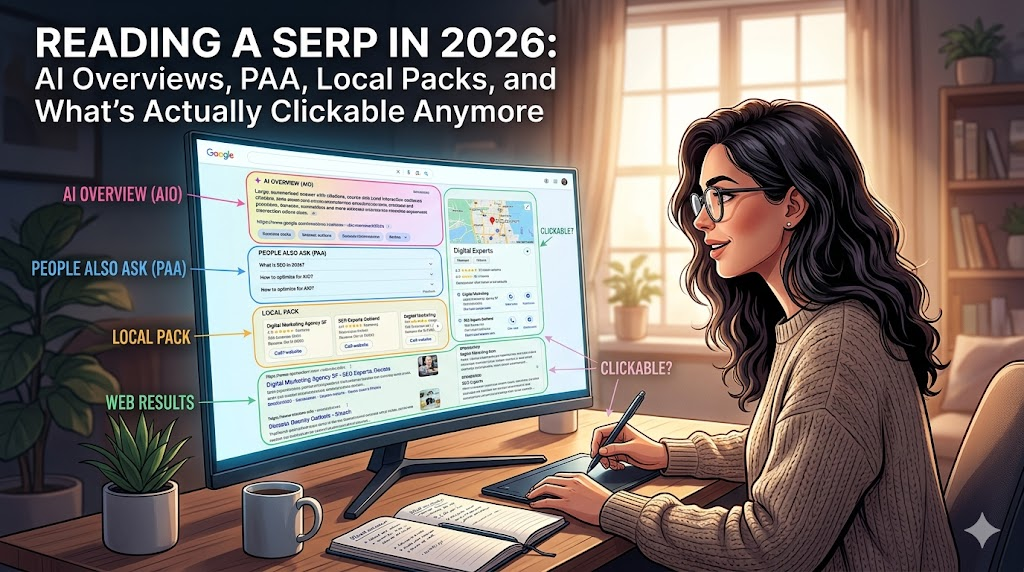
Summary: A Google results page in 2026 looks nothing like it did in 2022. AI Overviews dominate the top of the screen. People Also Ask boxes have expanded and evolved. Local packs are now more selective and AI-augmented. Traditional blue links have moved further down — and for a growing portion of queries, they barely get clicked at all. This guide maps every element of the modern SERP so you know exactly where traffic is coming from and where to compete.
“Businesses that still optimize for rank 3 on a blue-link SERP may be competing for a position nobody scrolls to anymore. Understanding the 2026 SERP means understanding that click behavior has been reorganized from scratch.”
The 2026 SERP — A Section-by-Section Map
Position 0: AI Overview
At the top of the page, before any traditional result, sits the AI Overview for a growing percentage of queries. It generates a summarized answer, often 3–6 paragraphs long, with cited sources appearing as small cards to the right or below the text.
What triggers an AI Overview:
- Informational queries (“how to,” “what is,” “best way to”)
- Comparison queries (“X vs Y”)
- Research queries (“benefits of,” “risks of”)
- Increasingly: transactional queries with a decision component (“best [category] for [use case]”)
What does not reliably trigger an AI Overview:
- Pure navigational queries (“Facebook login”)
- Brand-specific queries where the brand is the answer
- Very local, near-me transactional queries (though this is expanding)
CTR behavior: In SERP.fyi analysis of 2026 keyword tracking data, queries with an AI Overview show a 35–55% reduction in clicks to the first organic blue link result compared to the same query pre-Overview. However, businesses cited within the AI Overview itself see strong engagement — users click the cited card, not the organic result beneath it.
What this means for you: Being cited in an AI Overview is now a primary traffic opportunity. The path to citation is content that directly answers the query in a structured, quotable format — not content that ranks for keyword density.
Local Pack (Map Results)
For queries with local intent (“near me,” “[service] in [city],” or location-inferred from the user’s IP), a local pack appears — typically 3 listings, sometimes 2. This element has not gone away. If anything, it has become more important as organic blue links lose click share.
What has changed in 2026:
The local pack now sometimes includes an AI-generated preamble — a short sentence above the three listings that summarizes what to look for when choosing this type of business. This preamble pulls from GBP Q&A content, review text, and editorial sources.
Review count and recency are more visible than ever. The pack now shows a star rating, review count, and a “highlights” snippet pulled from recent reviews.
Booking and call buttons have become primary CTAs — many local pack clicks now go directly to a booking form rather than the business website.
Click distribution in local packs (SERP.fyi 2026 data):
| Pack Position | Average Click Share |
|---|---|
| Position 1 | 44% |
| Position 2 | 28% |
| Position 3 | 17% |
| “More places” link | 11% |
Position 1 in the local pack is worth roughly 2.5x position 3. Do not optimize for “getting into the pack” as a finish line — optimize for position 1 within it.
People Also Ask (PAA)
PAA boxes have grown substantially. They now appear multiple times on a single SERP — typically once after the local pack, once after the first cluster of organic results, and sometimes once more near the bottom. Each PAA box starts with 4 questions and expands infinitely as users click.
What has changed:
PAA answers in 2026 are frequently drawn from AI-generated synthesis rather than from a single page. This means winning a PAA slot is no longer about having the highest-ranking page — it is about having answer-formatted content that an AI model can cleanly extract.
Structure matters more than authority. A newer page with a direct, well-structured answer in the first two sentences will displace a decade-old authority page with a buried, paragraph-heavy answer.
The PAA opportunity:
Businesses that answer their own PAA questions — on their website, in their GBP Q&A, or in structured blog content — are far more likely to appear in these boxes. The questions are not random. They are pulled from patterns in actual user queries and are highly predictable within any given industry category.
Ads (Search and Shopping)
Paid search ads still appear at the top and bottom of the page, but they are visually distinct from AI content. On desktop, most users have developed strong ad-blindness for text ads, while Shopping ads (product images with prices) continue to attract clicks for commercial and product queries.
For local service businesses, Local Service Ads (LSAs) appear above the regular text ads and above the local pack in many markets. LSAs show a “Google Guaranteed” or “Google Screened” badge and drive direct phone calls. They are click-to-call by default.
For competitive local categories (lawyers, HVAC, dentists, plumbers), LSAs now appear prominently enough that they are the first element many users interact with — before the local pack, before the AI Overview.
Organic Blue Links
Traditional blue links remain — but their position on the page has shifted down significantly for informational and local queries. In SERP.fyi tracking of 400 target queries across 6 industries, the first organic blue link appeared:
- Above the fold (without scrolling) on desktop: 31% of queries
- Below the fold on desktop: 69% of queries
- Below the fold on mobile: 87% of queries
This does not mean organic ranking is worthless. High-intent transactional queries still produce strong click rates for top organic results. But for informational queries, the journey from ranking position 1 to receiving clicks is longer than it was, because more SERP elements sit above that result.
Where organic ranking still drives significant traffic:
- Branded queries (your own company name)
- High-specificity long-tail queries
- Comparison queries not yet fully dominated by AI Overviews
- Industry-specific queries where AI Overviews are thin or absent
Knowledge Panels and Entity Cards
For any search that involves a recognized entity — a business, a person, a product, an organization — a Knowledge Panel may appear on the right side of the desktop SERP (or as a card in mobile). For businesses, this is populated primarily from your Google Business Profile.
The Knowledge Panel now displays:
- Business description and primary category
- Hours and address
- Review aggregate
- Photos
- Social media links
- Q&A excerpts
- “People also search for” related entity suggestions
If your Knowledge Panel is thin, incomplete, or populated with outdated information, it actively undermines conversions from users who find you via other means.
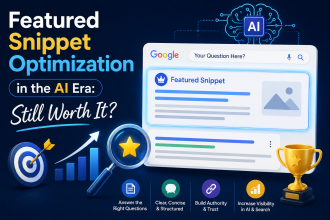
Featured Snippets
Featured snippets — the highlighted box that appears above organic results for definition-type and how-to queries — still exist but have contracted in frequency since AI Overviews expanded. Where an AI Overview appears, a featured snippet typically does not.
Featured snippets remain relevant for:
- Technical queries where AI Overviews are less confident
- Niche B2B topics
- How-to queries in regulated industries where AI tends to add caveats rather than direct answers
What Is Actually Clickable in 2026
Let us be direct about where users actually click, based on aggregated behavior patterns:
High click rate (still strong):
- Local pack results (position 1–3)
- AI Overview source citations
- Shopping ads for product queries
- Local Service Ads for service categories
- Knowledge Panel actions (call, book, get directions)
Medium click rate (declining):
- Organic position 1–3 for informational queries
- PAA expanded answers that link to sources
- Organic results for transactional queries not yet dominated by AI
Low click rate (substantially reduced):
- Organic positions 4–10 for any query type
- Text ads for non-commercial queries
- “More results” from local pack
Near-zero click rate:
- Organic results below the fold on mobile for any query with an AI Overview
- Position 6–10 for local, informational, or comparison queries
How to Compete on Every Layer
For AI Overviews: Create answer-formatted content. Short intro that summarizes the answer. H2/H3 structure. FAQ section. Data points. Direct prose. Avoid making users dig for the answer.
For local packs: Complete all 42 GBP fields, post weekly, seed your Q&A, and actively manage your review velocity.
For PAA: Research the “People Also Ask” questions that appear for your target queries. Write content that answers them in the first two sentences. Structure your pages with H2s that match the question format.
For Knowledge Panels: Complete your GBP, add social profiles, build consistent citations, and publish structured data on your website.
For organic results: Focus on long-tail, high-specificity queries and comparison content where AI Overviews have not yet displaced traditional results.
FAQ
Are blue links dead? No. But they are no longer the primary interface for a growing percentage of search intent types. Organic ranking remains important, especially for branded, long-tail, and B2B queries.
Should I stop investing in SEO? No. The signals that drive AI Overview citations, local pack ranking, and Knowledge Panel completeness are all SEO signals. The target outputs have diversified — the inputs (authority, relevance, entity completeness) remain the same.
How do I know if an AI Overview appears for my target queries? Run the query in an incognito window from a desktop browser in your target location. If you see a box with a “Generative AI” or AI-labeled summary above the organic results, an AI Overview is active for that query.
What kind of business benefits most from the current SERP structure? Local service businesses with fully optimized GBPs and strong review velocity benefit enormously from the current local pack and LSA prominence. Content publishers with well-structured, answer-focused pages benefit from AI Overview citations.
Is it worth paying for Google Ads given how crowded the SERP is? For high-commercial-intent queries, paid ads still deliver strong returns. For informational queries, ad spend is less efficient than it was — the AI Overview intercepts many of those clicks before they reach your ad.
How do I check what SERP features appear for my queries? Run them manually in incognito, or use a SERP analysis tool that tracks SERP feature presence by keyword.
Summary
The 2026 Google SERP is a layered interface where AI Overviews, local packs, PAA boxes, and Knowledge Panels each capture click behavior that once flowed to organic results. Understanding which layer is active for your target queries — and optimizing for the right element on each — is the difference between a content strategy that drives traffic and one that produces rankings that nobody clicks.
See how your brand shows up across every layer of the 2026 SERP. Run your audit at serp.fyi/register.