Summary: AI systems including ChatGPT, Perplexity, and Google’s AI Overviews are now actively recommending local businesses, products, and service providers in response to conversational queries. Most businesses have no idea whether they appear — or why they don’t. This 10-minute audit tells you exactly where you stand.
“The new first page of Google is not a page anymore. It’s an answer. The question is whether your business is in that answer.”
The Shift That Most Businesses Missed
Search used to work one way: you typed a query, got 10 blue links, and clicked. That model still exists, but it is no longer the dominant one for a growing category of high-intent queries.
Queries like “who is the best accountant for freelancers in Austin,” “what’s a trustworthy PR service for startups,” and “which dentist in my area takes Delta Dental and has good reviews” are now answered by AI systems — directly, conversationally, with named business recommendations — before the user ever sees a list of links.
In our monitoring across hundreds of business categories, we estimate that AI-generated recommendations now intercept somewhere between 15% and 40% of local and service-category queries depending on the niche. That percentage is growing month over month.
If your business is not in those AI-generated answers, you are invisible to that portion of your market. And most businesses have never checked.
This guide fixes that in 10 minutes.
What You Need Before You Start
You need access to three AI systems. All have free tiers:
- ChatGPT (chat.openai.com) — use GPT-4o if possible
- Perplexity (perplexity.ai) — this one cites its sources, which makes it especially useful for auditing
- Google (google.com) — look for the AI Overview box at the top of results, not regular links
You also need a clear sense of: your business name, your primary service, and your target city or region.
Set a timer. This takes 10 minutes if you move through it systematically.
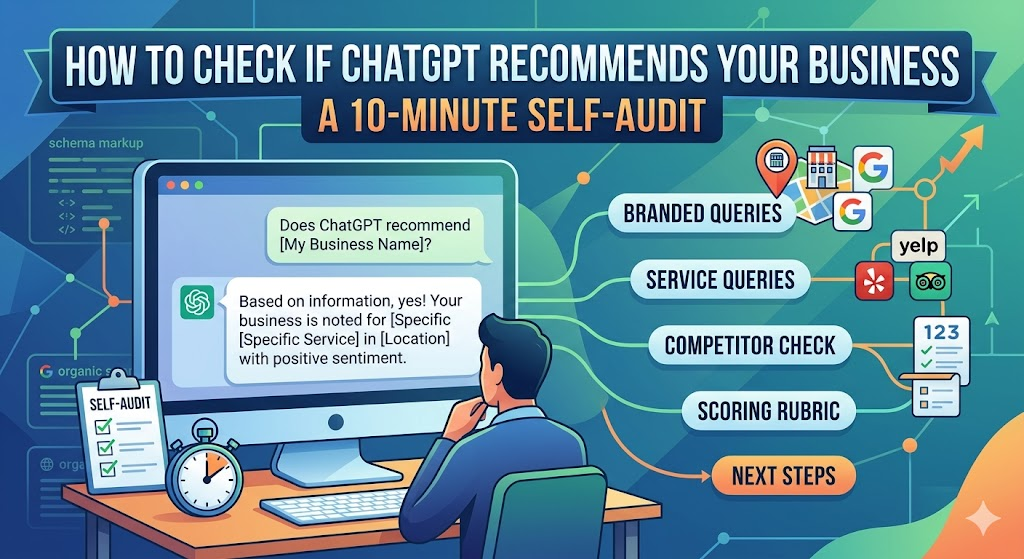
Step 1: The Direct Name Check (2 Minutes)
Open ChatGPT. Ask these three questions exactly as written, substituting your business name and category:
Query A: “What do you know about [Your Business Name]?”
Query B: “Is [Your Business Name] a reputable [your category]?”
Query C: “Have you heard of [Your Business Name] in [your city]?”
What to look for:
If the AI knows your business accurately, that is a positive signal. It means you have enough online presence that training data included credible information about you.
If the AI says it has no information, or if it hedges heavily (“I don’t have reliable information about that specific business”), you have a visibility gap. AI systems learn from publicly available data. If there’s nothing to learn from, you don’t exist to them.
If the AI generates information that is wrong — wrong location, wrong services, wrong founding year — that is actually worse than being unknown. Incorrect AI-generated information can be presented to users as confident fact. Note every inaccuracy you find.
Record your results. You’ll need them for Step 5.
Step 2: The Category Recommendation Test (3 Minutes)
This is the most important part of the audit. You are testing whether AI systems recommend your business when a user asks a question your business should answer.
In ChatGPT, ask:
“What are the best [your business category] in [your city]?”
Then ask a more specific version:
“I need a [your category] that [specific service you offer] in [your city]. Who would you recommend?”
Then a reputation-framed version:
“Which [your category] in [your city] has the best reviews and is most trusted?”
Do the same in Perplexity. Perplexity will show you which sources it is pulling from — this is valuable data. Note the sources. Are they review platforms? News articles? Your own website? Competitors’ websites?
Then go to Google and run:
“best [your category] [your city]”
Check whether an AI Overview appears above the regular results. If it does, read it carefully. Is your business mentioned? Whose business is mentioned and why?
Step 3: Interpreting Your Results — The 4 Scenarios
Scenario 1: You appear prominently and accurately. This is the goal state. You are in AI recommendations for your category. Your job now is maintenance: keep your review signals strong, keep your website content updated, keep your GBP current. Monitor monthly for drift.
Scenario 2: You appear but with errors. Partial visibility with incorrect information is a real risk. AI systems are confident even when wrong. The errors you found in Step 1 may be appearing in recommendations to real users. The fix is a content and citation cleanup — ensuring that the authoritative sources about your business contain accurate, current information that will correct the model’s understanding over time.
Scenario 3: You don’t appear but competitors do. This is the most common scenario. You exist online but haven’t built enough of the right signals. The competitors that AI systems are recommending have something you don’t — usually a combination of higher review volume, more authoritative third-party mentions, or stronger content signals. This is fixable, but it requires a deliberate strategy.
Scenario 4: Nobody in your category appears — AI declines to recommend. This happens in categories where AI systems have learned to be cautious (legal, medical, financial) or where local coverage is thin. In this scenario, the battle is not for AI recommendations yet — it’s for appearing in the sources that AI systems will eventually use when they do start recommending in your category. Build your presence in review platforms and authoritative publications now.
Step 4: The Source Audit — Where Is Your Business Actually Mentioned? (3 Minutes)
Go to Perplexity and ask:
“What are people saying about [Your Business Name]?”
Then:
“Where can I find reviews of [Your Business Name]?”
Perplexity will cite its sources inline. These citations reveal which platforms are contributing to your AI visibility. Typical sources include:
Google Reviews (pulled from GBP), Yelp, Trustpilot, BBB, industry-specific review sites, news articles, press releases, and your own website.
Now open a new tab and Google your business name. Look at the first page of results. Every result on page one is a source that AI systems can read and learn from. What do those results say about your business? Are they accurate? Positive? Current?
The gap between what AI says about you and what those sources actually say is your AI reputation gap. Closing that gap — updating outdated profile information, responding to old reviews, publishing new content — is how you change what AI systems say about you over time.
Step 5: Build Your AI Visibility Score (2 Minutes)
Score yourself on the following. One point per yes.
Direct recognition: ChatGPT knew your business existed. (+1) Accurate information: What it said was correct. (+1) Category recommendation: You appeared when asked for the best in your category. (+1) Multi-platform: You appeared in both ChatGPT AND Perplexity. (+1) Source quality: Perplexity cited authoritative sources about you. (+1) Review presence: You have reviews on at least two platforms AI systems are likely to pull from. (+1) Content currency: Your website has been updated in the last 90 days. (+1) GBP completeness: Your Google Business Profile is fully complete. (+1)
8/8: Strong AI visibility. Focus on maintenance and monitoring. 5-7: Partial visibility. Specific gaps to close. Prioritize the ones you missed. 3-4: Limited visibility. You are invisible to AI for most queries. Needs a structured fix. 0-2: Not visible. AI systems either don’t know you or know you inaccurately. Urgent.
What Drives AI Recommendation Visibility
Based on our analysis of businesses that consistently appear in AI-generated recommendations versus those that don’t, the pattern is clear:
| Signal | Impact Level |
|---|---|
| Google Business Profile completeness | Very High |
| Google review count and recency | Very High |
| Third-party platform review presence (Yelp, Trustpilot, etc.) | High |
| Press mentions and earned media | High |
| Website content quality and freshness | High |
| Consistent NAP (name/address/phone) across the web | Medium |
| Social media presence | Low to Medium |
| Paid advertising | No direct effect |
The last row is worth emphasizing. Running Google Ads does not make AI systems more likely to recommend you. Organic trust signals — reviews, citations, content — are what drive AI visibility.
Frequently Asked Questions
How often does ChatGPT update what it knows about businesses? GPT-4o has a knowledge cutoff but also has browsing capabilities in some configurations. For local business recommendations, it increasingly relies on real-time web data rather than training data alone. This means changes you make to your online presence can be reflected relatively quickly — within weeks rather than years.
Does a negative review affect whether AI recommends me? Yes, but not in a simple way. AI systems appear to evaluate overall reputation signals rather than individual reviews. A business with 200 reviews averaging 4.6 stars will be recommended despite having some negative reviews. A business with 8 reviews averaging 3.9 stars is likely below the threshold for confident recommendation.
Can I ask ChatGPT to recommend my business? No. Prompting an AI system to recommend a specific business doesn’t change its underlying behavior for other users. The signals that drive recommendations are built offline, in your actual online presence.
What if Perplexity cites a competitor’s negative review of my business? This is a real risk and one of the reasons reputation monitoring matters. If a negative article or review is one of the top results when AI searches for your business name, it becomes a source in AI-generated answers. Suppressing or replacing that content in search results also reduces its AI visibility.
How is this different from regular SEO? Traditional SEO focuses on ranking in a list of links. AI visibility focuses on being named and recommended in a conversational response. The underlying signals overlap significantly — reviews, content quality, authoritative mentions — but the output is different. You can rank on page one in traditional search and still be invisible in AI answers.
How do I track this over time? Run this 10-minute audit monthly. Keep a log of what each AI system says about you. Changes in AI recommendation behavior are one of the earliest signals of reputation shifts, often visible weeks before they show up in traditional ranking data.
Summary
Most businesses have never checked whether AI recommends them. Most have never asked ChatGPT their own business name. Most have no idea whether the AI answers their potential customers are receiving are accurate, or whether they’re even in those answers at all.
The 10-minute audit above changes that. It gives you a clear picture of your current AI visibility, where the gaps are, and what the highest-leverage fixes are.
The businesses that will win local and category-level search in 2026 and beyond are not the ones spending the most on ads — they’re the ones that AI systems have learned to trust. Trust is built from the ground up: reviews, citations, content, consistency.
Run your own audit at serp.fyi/register and see exactly how your brand scores across AI platforms, search engines, and reputation signals — in one dashboard.