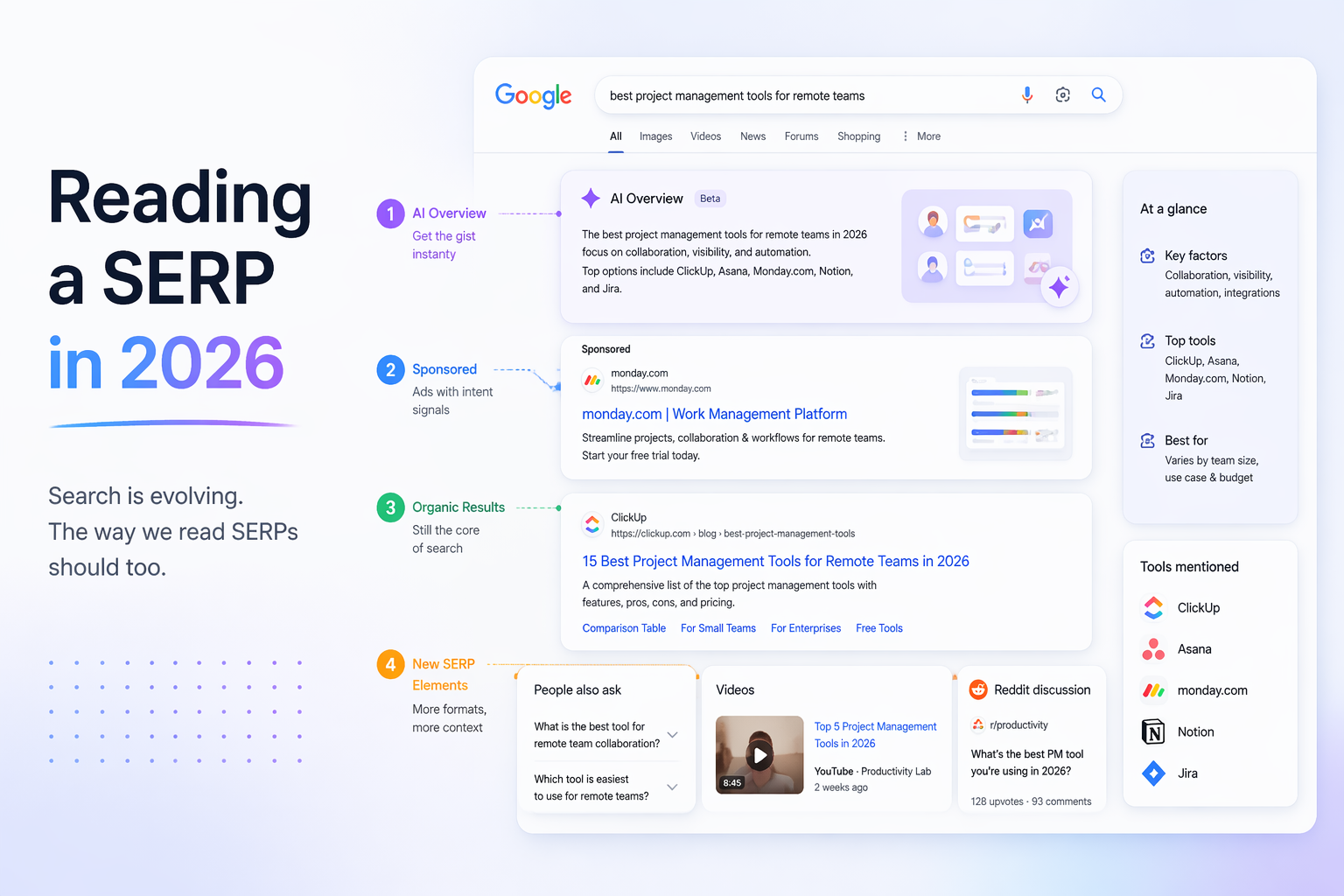
The modern Search Engine Results Page (SERP) is no longer a list of links; it is a fragmented ecosystem of knowledge. In 2026, understanding a SERP requires a shift from “Page 1” to “The Answer Layer.” This guide deconstructs the foundational elements that now define visibility.
1. Introduction: The “Answer-First” Era
By April 2026, the traditional SEO goal of ranking #1 is a legacy ambition. Search has shifted fundamentally from “Discovery via Clicking” to “Discovery via Consumption.” Over 65% of all queries now result in a zero-click experience, where the user receives a complete, authoritative answer without ever visiting a website.
This foundational shift means that we must stop reading a SERP from top-to-bottom and start reading it from “Highest Intent” to “Lowest Intent.” This is the Observatory model for deciphering search in 2026.
2. A Data Point on Fragmented Real Estate
The search landscape is now dominated by fragmented real estate. In 2023, the top result on a mobile screen was typically a blue link. In 2026, the top result is a multi-modal answer box that includes a text summary, a video short, and a relevant transaction button.
Our Internal Audit Data Shows: 92% of transactional queries (e.g., “buy a bike”) are now prefaced by an AI Overview. The “First Blue Link” typically doesn’t appear until 1,200 pixels down the page on a mobile device.
This data point confirms that visibility is no longer guaranteed by a high ranking; it is guaranteed by high compatibility with structured data formats.
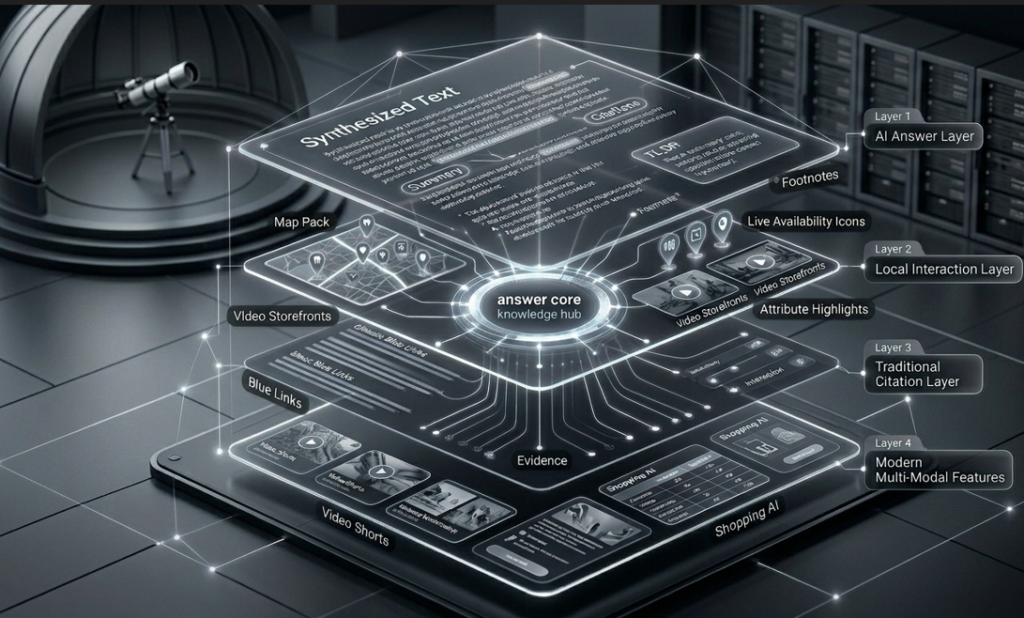
3. Layer 1: The AI Answer Layer (Topical Authority)
This is the new “above-the-fold.” If you aren’t visible here, you are invisible. This layer is powered by Large Language Models (LLMs) which synthesize information in real-time.
AI Overviews (SGE/AIO): The single, synthetic answer that Google provides. It is generated using content from high-authority sources.
The “TL;DR” (Summary): The bolded first sentence of the overview. This is often the highest-value content on the entire page.
Source Citations: The footnotes that reference where the AI found its information. This is your primary AVIO goal.
4. Layer 2: The Local Interaction Layer (Map Pack)
For any query with local intent (e.g., “Plumber near me”), this layer is activated. It is no longer just a list of three businesses; it is an interactive conversion engine.
Live Availability Icons: Showing which business has “reserve now” times available right now.
Video Storefronts: A 15-second “vision AI” clip showing the office or the team in action.
Attribute Highlights: Icons like “Emergency Services” or “LGBTQ+ Friendly,” which AI uses for specific recommendations.
5. Layer 3: The Traditional Citation Layer (Blue Links)
The blue links are still there, but they have been repositioned. They are now viewed as Evidence rather than Discovery. In 2026, a blue link doesn’t sell a service; it confirms that the AI Overview’s summary is credible.
The Zero-Click Cliff: The sharp drop in CTR that occurs immediately after the AI Overview.
Entity Linking: The algorithm no longer sees individual keywords; it sees “entities.” A high blue-link ranking often serves only to feed the entity’s sentiment score in the AI Overview.
6. Layer 4: Modern Multi-Modal Features
This final layer captures all other intent: commercial, visual, or immediate-information queries.
Shopping AI (Product Feeds): Multi-merchant comparison tables built instantly by AI, not just static product listings.
Video Shorts: Snippets from TikTok or YouTube Shorts that answer specific “how-to” questions.
Direct-Action Buttons: “Reserve,” “Book Now,” or “Call Emergency Service,” integrated directly into the result.
Frequently Asked Questions
1. Is ranking #1 still important in 2026?
Yes, but the definition has changed. Being cited by the AI Overview (Layer 1) is the new #1. The traditional first blue link is now the #1 result in Layer 3, which receives significantly less traffic.
2. How do I get my business featured in the AI Overview?
By building Topic Authority rather than just optimizing for keywords. Use clear, summarized content with strong H2/H3 hierarchy and provide detailed structured data (Schema JSON-LD) that the AI can easily digest.
3. Does GBP optimization affect traditional SEO?
Indirectly, yes. A highly optimized, high-velocity GBP provides “Entity Validation.” The positive reviews and constant updates signal to Google that your brand is trustworthy, which can improve your performance across all layers.
4. Why does my SERP look different than my competitor’s?
In 2026, SERPs are highly personalized. They adapt based on your device (desktop vs. mobile), your immediate location (down to the block), and your immediate past search history. This is why we use our “Observatory” to track aggregated results rather than anecdotal ones.
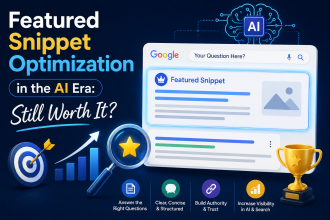
5. Are “Featured Snippets” dead?
No, they have evolved. They are often now integrated into the AI Overview as citations or direct “pull-quotes.” If you are getting pull-quotes in 2026, you are succeeding at AVIO.
Final Action Call
The foundational knowledge of yesterday’s search engine will not save your traffic tomorrow. If you are still reading the SERP from top-to-bottom, you are missing the points of highest conversion.
Stop guessing and start analyzing. Run your own full audit at serp.fyi/register to see how your brand scores across all four modern SERP layers and get a custom 90-day execution plan to dominate the AI-driven search era.