Google and every major AI answer engine run on the same underlying idea: the world is made of entities, not keywords. If your brand isn’t an entity in their knowledge graph, you’re invisible no matter how much you publish.
| SUMMARY |
| An entity is a distinct, named thing a person, brand, product, place, or concept that knowledge systems can reason about. AI answer engines don’t search for keywords. They reason about entities and their relationships. If your brand lacks entity recognition, AI systems can’t confidently cite you — even if you rank in organic search. Entity recognition is built through consistent signals across authoritative sources, not through a single fix. This guide explains what entities are, why they matter for AI visibility, and how to build recognition systematically. |
What is an entity really
The word gets used loosely, so let’s be precise. In the context of knowledge systems, an entity is a distinct, uniquely identifiable thing in the world that can be described, related to other things, and reasoned about. Entities have attributes (properties), relationships (connections to other entities), and an identifier that distinguishes them from everything else.
Google’s Knowledge Graph the database that powers the information panels you see in search results is built entirely from entities. So is Wikidata. So, increasingly, is the world model that underlies every major AI answer engine. When ChatGPT tells you that a company was founded in a particular year by a particular person in a particular city, it’s not retrieving a web page. It’s querying a structured representation of entities and their relationships.
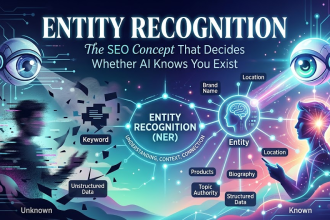
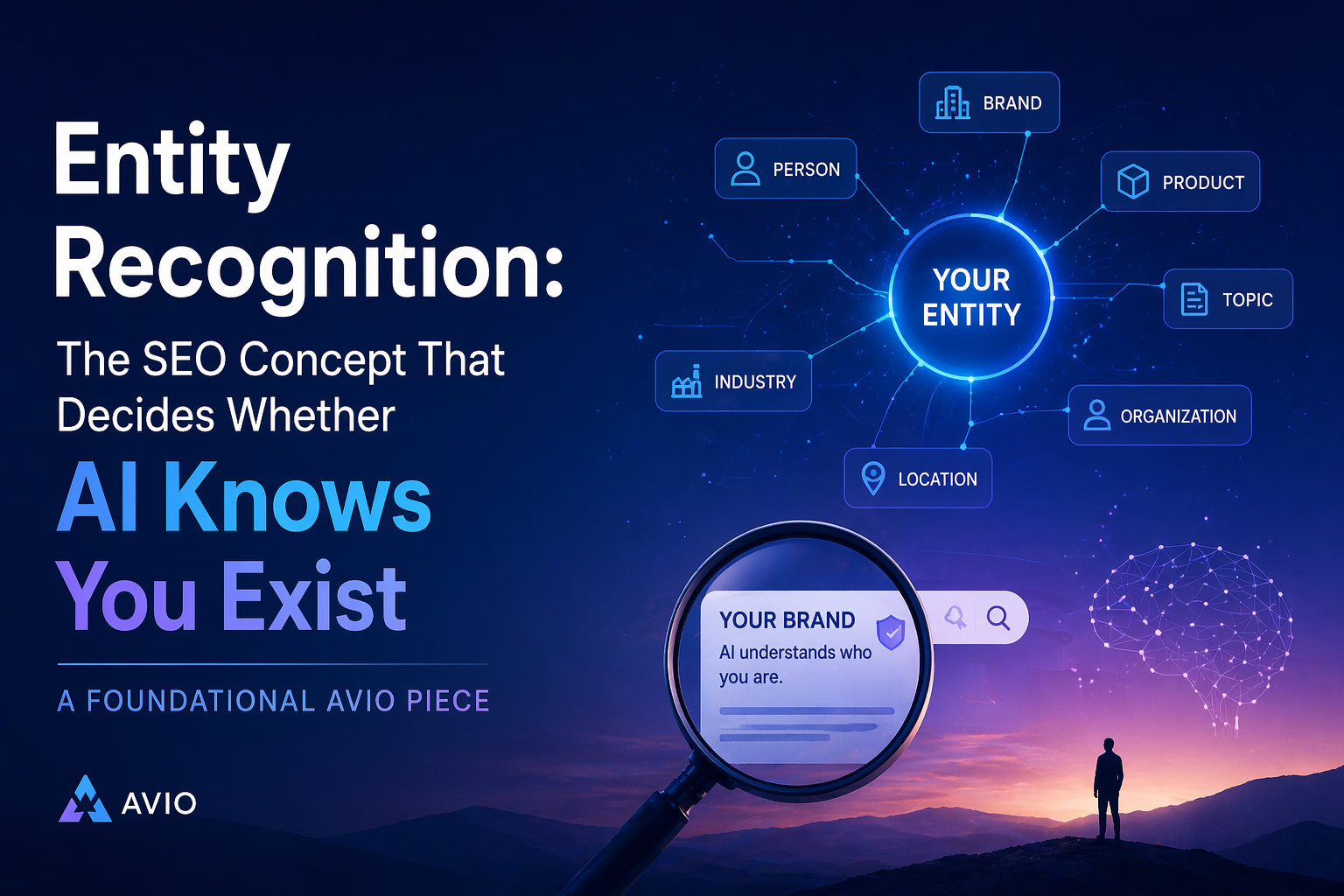
A brand entity is a node in a network defined by its relationships to other nodes: its founders, its location, its industry, its competitors, its products. The richer those relationships, the more confidently a system can reason about what that entity is, what it does, and when to surface it.
Why AI answer engines care deeply about entities
Traditional keyword search is a matching problem: find pages that contain the words in the query. Entity-based reasoning is a different operation entirely: identify what concept the user is asking about, retrieve structured knowledge about that entity, and synthesise an answer.
This distinction has enormous implications for visibility. When someone asks “what’s the best CRM for small businesses,” a keyword-based system looks for pages containing those words. An entity-based system identifies “CRM software” as a product category entity, retrieves the entity graph of known CRM products, filters by attributes (price tier, target market), and selects from entities it knows and trusts. If your CRM product isn’t a recognised entity in that graph, it cannot appear in the answer not because it’s ranked lower, but because it doesn’t exist in the system’s world model.
| The key shift: Keyword SEO asks “does my page appear in results?” Entity SEO asks “does my brand exist in the knowledge model?” These are fundamentally different questions with different answers. |
The entity gap why most brands are invisible to AI
In our Observatory dataset of 1,200 domains, only 34% had what we classify as strong entity recognition a consistent, cross-referenced presence in at least three authoritative knowledge sources. The remaining 66% existed on the web but not reliably in AI knowledge models.
| 34% of domains have strong entity recognition | 4.7×more AI citations for strongly-recognised entities | 3+ authoritative sources needed for reliable entity status |
The most common failure patterns: a brand that exists only on its own website with no external corroboration; a brand with inconsistent name/description across sources (known as entity fragmentation); and a brand that’s confused with a similarly-named entity in a different sector.
| Keyword SEO mindset | Entity SEO mindset |
| • Rank pages for terms • Build backlinks for authority • Optimise title tags and metadata • Publish volume of content • Target search intent | • Establish your brand as a known entity • Build cross-source corroboration • Define attributes consistently • Publish authoritative entity signals • Occupy a named position in a knowledge graph |
How entity recognition actually works
Knowledge systems whether Google’s Knowledge Graph, Wikidata, or the world models underlying AI engines recognise entities through a process of corroboration. A single mention of your brand name on a single website proves nothing. Recognition happens when multiple independent, authoritative sources describe the same entity with consistent attributes.
The three conditions for entity recognition
| Name | Description | |
| Condition 1 | Uniqueness | The entity must be distinguishable from all other entities. “Apex” is not a unique entity. “Apex Digital Marketing, London, founded 2019” begins to be. |
| Condition 2 | Corroboration | Multiple independent sources describe the entity with consistent attributes. Your own website claiming you exist is necessary but not sufficient. |
| Condition 3 | Relationships | The entity is connected to other known entities people, places, categories, competitors. Isolated entities with no graph connections are weakly recognised. |
| Bonus | Structured signals | Schema markup, Wikidata entries, and an llms.txt file give systems machine-readable confirmation of attributes without requiring inference. |
| Common misconception: Many brands assume that having a Wikipedia page equals entity recognition. It helps significantly but Wikipedia is one source. Recognition requires corroboration across multiple independent references. A Wikipedia page with no external citations is weaker than you’d expect. |
Building entity recognition: the signal hierarchy
Not all entity signals are equal. Some carry structural authority they’re the sources knowledge systems treat as ground truth. Others carry corroborative weight they confirm and reinforce what the authoritative sources say. Here’s how the hierarchy works in practice.
| Signal source | Type | Strength | Notes |
| Wikidata entry | Structural | ● ● ● ● ● | Primary source for knowledge graphs. Machine-readable entity definition. |
| Wikipedia article | Structural | ● ● ● ● ○ | High authority but requires notability threshold. Links to Wikidata. |
| Organization schema | Structural | ● ● ● ● ○ | Machine-readable self-description. Include sameAs to link to Wikidata/Wikipedia. |
| llms.txt file | Structural | ● ● ● ○ ○ | Emerging signal. Directly addresses AI retrieval systems. |
| Press coverage (major) | Corroborative | ● ● ● ● ○ | Third-party corroboration. Powerful when name + category + attributes are stated. |
| Industry directories | Corroborative | ● ● ● ○ ○ | Crunchbase, G2, Capterra, LinkedIn. Consistent NAP-equivalent for digital entities. |
| Podcast / interviews | Corroborative | ● ● ○ ○ ○ | Increasingly indexed. Useful for founder/person entity recognition. |
| Social profiles (official) | Corroborative | ● ● ○ ○ ○ | Weak alone, but confirm name consistency and provide graph connections. |
Your entity recognition action plan
Entity recognition is built systematically over weeks and months not overnight. Here’s the sequence that moves the needle fastest based on our audit data.
| 1 | Audit your current entity statusSearch your brand name in Google and check whether a Knowledge Panel appears. No panel = no entity recognition. Also check whether your Wikidata entry exists (wikidata.org) and whether it’s linked from your website’s Organization schema. |
| 2 | Create or claim your Wikidata entryThis is the single highest-leverage structural action. A Wikidata entry provides a permanent, machine-readable entity ID (a “Q number”) that knowledge systems use as a canonical reference. Include: legal name, founding date, HQ location, industry, key people, and links to your website and Wikipedia page if one exists. |
| 3 | Add Organization schema to your homepage and about pageInclude name, url, foundingDate, description, industry, numberOfEmployees, and critically sameAs links to your Wikidata entry, Wikipedia page, Crunchbase profile, and LinkedIn company page. The sameAs property tells knowledge systems these different references all describe the same entity. |
| 4 | Publish your llms.txt file with a clear, consistent entity descriptionYour description in llms.txt should use the same language, categories, and attributes as your Wikidata entry and Organization schema. Consistency across sources is itself a corroboration signal. |
| 5 | Build corroborative coverageIdentify industry directories where your entity should be listed (Crunchbase, G2, Capterra, your vertical’s specific directories) and ensure your name, description, and category are consistent across all of them. Pursue press coverage that names your brand, category, and at least two attributes in the same article. |
| 6 | Measure your entity recognition scoreRun an AI citation audit to test whether AI systems correctly identify your brand, its category, its products, and its differentiators when answering relevant queries. This is the ground-truth test of whether your entity recognition work is landing. |
| Timeline expectation: Structural signals (Wikidata, schema) are processed within 2–6 weeks of publication. Corroborative signals take longer knowledge systems cross-reference sources over multiple crawl cycles. Full entity recognition for a new brand typically takes 3–6 months of consistent signal-building. |
FAQ
My brand ranks on page 1 of Google. Does that mean I have entity recognition?
Not necessarily. Keyword ranking and entity recognition are different systems. You can rank highly for terms without being a recognised entity. Check whether a Knowledge Panel appears when you search your brand name; that’s the clearest indicator of entity status in Google’s system.
We’re a small company. Can we realistically get entity recognition?
Yes Wikipedia has a notability threshold that excludes most small companies, but Wikidata does not. Any brand can create a Wikidata entry. The challenge for small brands is building corroborative coverage, but even modest press mentions combined with strong schema markup and a Wikidata entry can establish meaningful entity recognition.
What’s ‘entity fragmentation’ and how does it hurt us?
Entity fragmentation happens when different sources describe your brand with inconsistent attributes different names (e.g. “Acme” vs “Acme Inc.” vs “Acme Digital”), different founding years, different descriptions. Knowledge systems interpret inconsistency as ambiguity and lower their confidence in the entity.
Is entity recognition the same as E-E-A-T?
Related but not identical. E-E-A-T is Google’s quality evaluator framework, which overlaps significantly with entity recognition signals. A well-recognised entity with strong corroborative coverage will typically score well on E-E-A-T, but E-E-A-T concerns content quality evaluation while entity recognition is about whether the brand exists as a known object in a knowledge model.
How often should I re-audit my entity recognition?
Quarterly is the right cadence for most brands. Entity recognition can degrade as well as improve a competitor acquisition, a rebrand, or a wave of inaccurate press coverage can all introduce fragmentation. A quarterly AI citation audit tells you whether your entity representation has drifted and what’s causing it.
| Check your entity recognition status Find out whether AI systems recognise your brand as a trusted entity or confuse you with a competitor. Your audit report shows entity signal strength, brand representation accuracy, and the specific gaps to fix. → Run your own audit at serp.fyi/register |