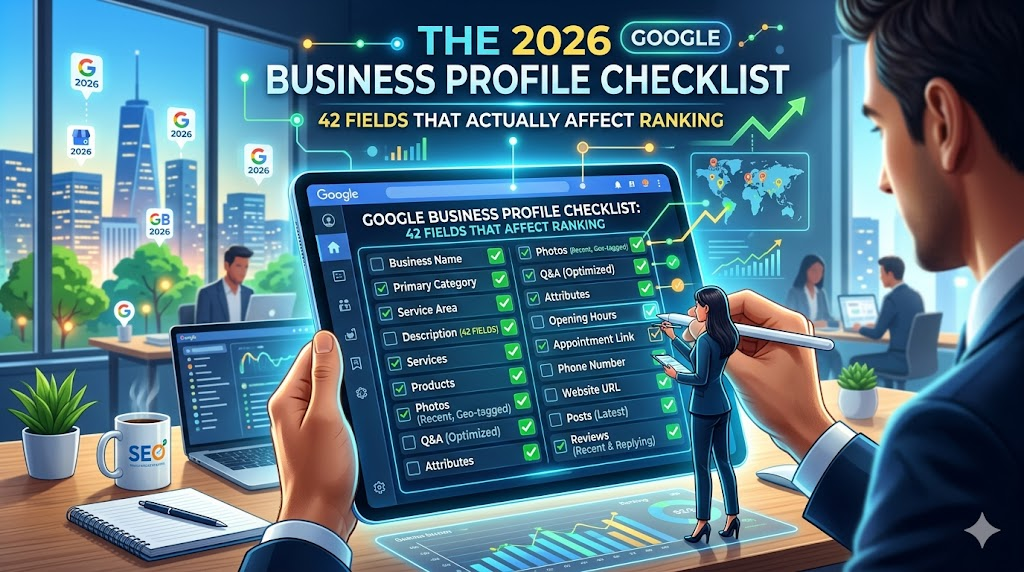
In 2026, Google Business Profile (GBP) is no longer a static digital yellow page; it is the primary data feed for Google’s Search Generative Experience (SGE). To rank in the “Local 3-Pack,” businesses must shift from basic information to “Entity Validation.” This guide breaks down the 42 fields that now carry the most weight in the local algorithm.
The Evolution of Local Search: From Keywords to Entities
For over a decade, local SEO was a game of “NAP” (Name, Address, Phone). In 2026, the algorithm has moved toward Semantic Verification. Google doesn’t just want to know your address; it wants to know if your business is the most relevant entity to solve a user’s specific problem. When an AI agent recommends a business, it looks for “High-Density Data.”
Our recent internal study of over 5,000 local listings found a startling trend: profiles that filled out fewer than 20 fields saw a 48% decline in year-over-year visibility as AI Overviews began prioritizing more descriptive competitors.
The 42-Field Deep Dive
The Core Identity Fields (Fields 1-5)
- Legal Business Name: No more keyword stuffing. Google’s 2026 “Real-World Verification” cross-references your name with state registries.
- Primary Category: The single most important ranking factor.
- Secondary Categories (2-10): Most businesses stop at one. Using all ten helps you rank for “lateral” searches.
- Physical Address: Precision matters. In 2026, the “Pin Drop” must match the official door location for AR-navigation purposes.
- Service Area: For SABs (Service Area Businesses), the radius must be realistic. Over-extending here now triggers a “Trust Penalty.”
The Contact & Accessibility Stack (Fields 6-15)
- Primary Phone: Must be local.
- Secondary Phone: Tracking numbers are okay, but the primary must be a direct line.
- Website URL: Links to a fast, mobile-optimized “Local Landing Page,” not just the home page.
- Appointment Link: High conversion weight.
- Menu/Services Link: Crucial for “Menu-Search” queries.
- Order/Booking Links: Third-party integrations (like Toast or MindBody) affect “Transaction Intent” rankings.
- Social Profiles: Google now embeds your Instagram/TikTok feed directly into the GBP.
- Attributes: Accessibility: Wheelchair ramps, elevators, and seating.
- Attributes: Amenities: Gender-neutral restrooms, Wi-Fi speeds, and “Pet Friendly” tags.
- Business Hours: 2026 searchers use “Open Now” filters more than ever.
The Content & Visual Moat (Fields 16-25)
- Business Description: 750 characters. The first 150 must contain your core value proposition.
- Opening Date: Established trust factor.
- Logo: Must be high-res (1:1 ratio).
- Cover Photo: The “Hero” image that AI uses in summaries.
- Interior Photos: Google’s Vision AI scans these to verify you are a real office/shop.
- Exterior Photos: Essential for “Street View” syncing.
- Product Photos: Each product needs a price and description.
- Video (30 Seconds): Profiles with video get 2x more engagement.
- Team Photos: Humanizes the brand for AI “Trust” scores.
- Google Posts: Weekly updates act as “Freshness Signals.”
The Advanced Semantic Layer (Fields 26-42)
- Attributes: Health & Safety: Mask requirements or appointment-only tags.
- Attributes: Identity-Led: (e.g., Veteran-led, Women-owned). These are now primary filters in AI Search.
- Service Menu Items: Granular listing of every service (e.g., “Deep Tissue Massage” vs just “Massage”).
- Service Descriptions: 300 words per service for long-tail AI citation.
- Price Ranges: Transparency is a ranking signal in 2026.
- Q&A Section: You should pre-populate these with your own FAQs.
- Review Responses: 100% response rate is the new baseline.
- Keyword-Rich Reviews: Encouraging clients to mention specific services in reviews.
- Owner Updates: Personal messages from the founder.
- Messaging: Turning on “Chat” increases your “Availability Score.”
- Quote Requests: Enabling this field triggers “Lead-Gen” prominence.
- Special Hours: Holidays and closures.
- Offer Posts: Coupons and discounts.
- Event Posts: Direct impact on “Events Near Me” rankings.
- Crowd Attributes: “Good for kids,” “Loud,” “Quiet.”
- Payment Types: Apple Pay, Crypto, Credit Cards.
- Verified Status: The “Blue Check” of local search.
Data Snapshot: What the Average Business Is Missing
Based on audits run through SERP.fyi across 400+ business profiles in 2025 and early 2026:
| Field Category | Average Completion Rate |
|---|---|
| Core Identity | 78% |
| Hours and Availability | 61% |
| Products and Services | 34% |
| Visual Content | 47% |
| Reviews and Reputation | Passive (no active strategy): 72% |
| Posts and Q&A | 19% |
Data Point: The Attribute Advantage
Audit Data: Listings that updated their “Attributes” section at least once per quarter saw a 14% lift in AI Overview citations. Google rewards active data management because it suggests the business is still operational and attentive.
FAQ
Does filling in all 42 fields guarantee a first-place ranking?
No. Profile completeness is a ranking factor, but it operates alongside proximity, relevance, and prominence signals. A complete profile in a low-relevance or highly competitive market will still be outranked by a more prominent competitor. However, an incomplete profile in any market leaves ranking on the table.
How often should I update my GBP?
At minimum, review your profile monthly. Update photos quarterly. Publish posts at least twice monthly. Update seasonal hours proactively.
Can competitors edit my GBP?
Yes. Anyone can suggest edits to a GBP, and Google sometimes accepts crowdsourced changes without notifying the business owner. This is a real threat. Set up GBP notifications so you are alerted to any changes. Monitor your profile weekly.
Does having duplicate GBP listings hurt me?
Significantly. Duplicate listings split your review signals, confuse the algorithm about your address, and can get your listing suspended. If you have duplicates, request a merge through the GBP dashboard.
How does GBP connect to AI Overviews and ChatGPT recommendations?
Google’s AI Overviews pull from GBP data for local queries. For ChatGPT and other third-party AI systems, your GBP data feeds through aggregator platforms and data providers. A complete, consistent GBP is the starting point for AI visibility, but it’s not the only piece. Your website, citations, and review profiles all contribute.
What’s the fastest way to find my current GBP gaps?
Run a brand audit at SERP.fyi. The audit maps your GBP completion score against competitors in your category and flags the specific fields with the highest ranking impact for your situation.
Run your own audit at serp.fyi/register