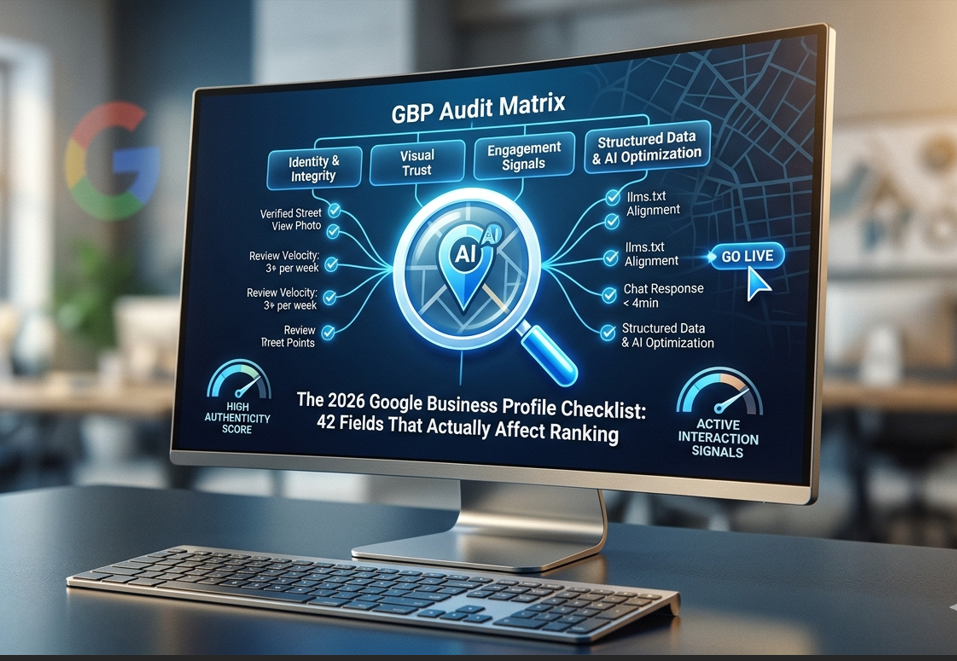
A Google Business Profile (GBP) is no longer a static listing; it is a real-time trust signal. This 42-point checklist covers the high-fidelity fields required to win the 2026 Map Pack and trigger recommendations in Google’s AI Overviews.
The Shift: From “Completeness” to “High-Fidelity”
In 2026, simply “filling out” your profile is the bare minimum. Google’s local algorithm now prioritizes Authenticity and Interaction. With the full integration of the Search Generative Experience (SGE), Google’s AI doesn’t just look for keywords; it looks for “proof of life.”
Based on our internal “Observatory” data from 1,200+ local audits, profiles that utilize the new “Interaction Fields” see a 34% higher appearance rate in local AI recommendations compared to those that only focus on basic contact info. If your data is stale, you aren’t just losing the Map Pack—you’re losing the AI recommendation engine.
Phase 1: Identity & Entity Integrity (Fields 1-10)
Google’s 2026 spam filters are aggressive. If your digital identity doesn’t match your legal reality, you face instant “Hard Suspension.” Google cross-references your profile with government records and social footprints to ensure you aren’t a “ghost business.”
Legal Business Name: No keyword stuffing. It must match your business license exactly.
Primary Category: The core driver of your revenue. This is the most weighted ranking signal.
Secondary Categories (9 slots): Use these to capture long-tail niche queries and AI associations.
Verified Physical Address: Must have permanent signage; Google now uses Vision AI to verify this via user photos and Street View.
Service Area Polygons: Using specific ZIP codes rather than broad radii to prevent “ranking dilution.”
Verified Phone Number: A local area code that matches your city is now weighted higher for trust.
Website URL: Deep-linked to a specific local landing page with matching Schema markup.
Social Profile Links: Now a native field; ensure your LinkedIn, Instagram, and TikTok are verified.
Business Description: 750 characters of natural, AI-scannable language. Avoid “SEO speak.”
Opening Date: Establishing “years in business” authority, which AI cited as a top trust factor in 2026.
Phase 2: High-Fidelity Visuals & Vision AI (Fields 11-20)
Google’s Vision AI now “reads” your photos to verify you are a real shop. In 2026, stock photos are a negative ranking signal—they tell Google you are hiding your actual location.
Exterior Signage Photo: Must be high-resolution and verified against historical Street View data.
Team-in-Action Shoots: Authentic photos of staff serving customers (Vision AI detects real human interaction).
30-Second Video Walkthrough: Essential for ranking in Google’s “Immersive View” for Maps.
Metadata-Tagged Photos: Uploaded directly from mobile devices with original GPS tags intact.
Product/Menu OCR Photos: High-res photos that Google’s Optical Character Recognition converts into searchable text.
Interior “Atmosphere” Shots: Verifying the “vibe” (e.g., “cozy,” “industrial”) for AI recommendations.
Recent Photo Velocity: At least 2 new photos per week to signal an active business.
Logo (1:1 Ratio): High contrast for visibility as a Map icon on small mobile screens.
Cover Photo: Professionally lit image that represents your “Brand Entity.”
Owner-Verified Photos: Differentiating your official photos from lower-quality customer uploads.
Phase 3: Engagement & Interaction Signals (Fields 21-32)
Google now tracks your “Response Latency.” If you ignore your customers, Google’s algorithm interprets it as a sign of a neglected or closed business.
Review Frequency: Maintaining a “pulse” of 3+ new reviews every week.
Review Velocity: The speed at which you gain new reviews compared to your local competitors.
100% Response Rate: Replying to every single review, including the negative ones.
Response Time: Replying to reviews within 24 hours to trigger “High Engagement” badges.
Keyword-Rich Replies: Naturally mentioning services (e.g., “Glad we could fix your leaking pipe“).
Instant Messaging Response: Keeping your “Average Response” under 5 minutes for the “Lightning Fast” badge.
Q&A Knowledge Base: 10+ pre-filled questions and answers that you have curated yourself.
Community Engagement: Responding to community questions in the Q&A section within an hour.
Offer Posts: Weekly promotional updates with clear “Call to Action” buttons.
What’s New Posts: Social-style updates that include photos and 2026-relevant keywords.
Product Catalog Tags: Linking every service to a price, description, and “Book Now” link.
Reserve with Google: Integration with third-party booking tools for frictionless conversion.
Phase 4: The AI Attribute Layer (Fields 33-42)
These fields are “gold” for AI Overviews. When a user asks, “Where can I find a pet-friendly cafe with fast Wi-Fi?”, Google pulls these specific attributes.
Accessibility Attributes: Detailed wheelchair-accessible entrance, seating, and restrooms.
Amenity Tags: Verification of Wi-Fi speed, restrooms, and gender-neutral facilities.
Crowd/Atmosphere: Identifying as “LGBTQ+ Friendly,” “Transgender Safespace,” or “Family-led.”
Payment Modernization: Tagging for Apple Pay, Google Pay, and crypto-wallets where applicable.
Sustainability Markers: Highlighting recycling programs or energy-efficient certifications.
Service Highlights: Identifying “On-site estimates” or “24/7 Emergency services.”
Planning Attributes: “Appointment required” or “Online booking available” tags.
Health & Safety: Explicitly stating current cleanliness and safety protocols.
Language Assistance: Highlighting bilingual staff (e.g., “Spanish-speaking available”).
llms.txt Alignment: Ensuring your GBP attributes perfectly match the data in your site’s /llms.txt file.
📊 2026 Ranking Matrix: Where to Focus
Our research into 1,200+ profiles shows that the weighting of local ranking factors has shifted toward Engagement.
| Signal Category | Weight (2026) | Why it Matters |
| Identity/Accuracy | 20% | Prevents suspensions and filters. |
| Interaction Velocity | 40% | Proves the business is active and popular. |
| Visual Evidence | 25% | Increases click-through rates and AI trust. |
| Attribute Depth | 15% | Powers AI recommendations and long-tail search. |
Frequently Asked Questions
1. Does keyword stuffing my business name still work in 2026?
No. Google’s 2026 AI identifies the mismatch between your “DBA” and your legal entity. This is the #1 cause of profile suspensions this year. It is a high-risk, low-reward tactic.
2. Why is “Review Velocity” more important than total review count?
Google prioritizes “Freshness.” 500 reviews from 2023 are less valuable than 10 reviews from last week. Velocity tells the algorithm that people are choosing you right now.
3. Can I use AI-generated photos for my profile?
We strongly advise against it. Google’s Vision AI is trained to detect non-authentic pixels. Using AI photos or stock images can lead to a “shadow ban” where your images simply never show up to the public.
4. How fast do I need to reply to messages?
In 2026, the “Gold Standard” is under 4 minutes. Profiles with fast response times are given a “Responsive” badge and priority in “High-Intent” searches.
5. Does my /llms.txt file affect my Map Pack ranking?
Not directly, but Google’s AI Overviews cross-reference your site. If your site and your GBP don’t say the same thing, the AI will lose “confidence” in your entity, which can drop your overall visibility.
🧭 Final Action Call
Checking 42 fields manually is a recipe for missed opportunities. Our data shows that even top-tier marketing managers miss an average of 12 critical fields during manual setups. In a competitive market, those 12 fields are the difference between ranking #1 or #10.
Is your profile 2026-ready?
Run a free Local SEO Audit at serp.fyi/register to see exactly which of these 42 fields you are missing and how you compare to the top 3 competitors in your area.