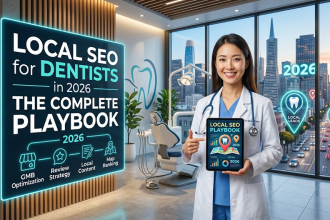
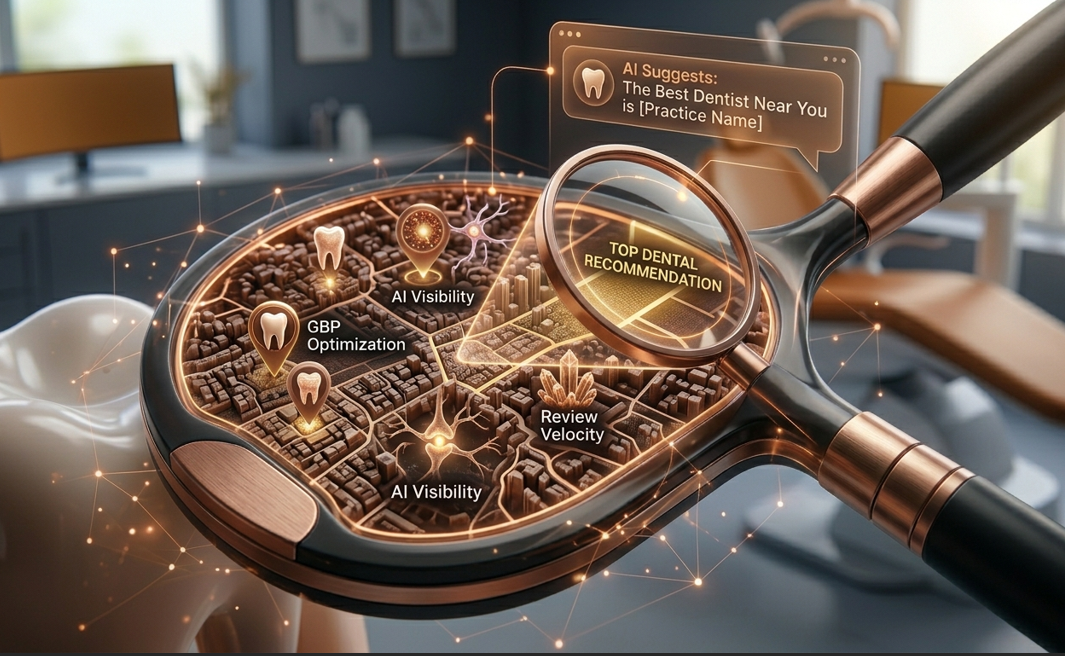
Dental marketing in 2026 is no longer just about “near me” searches. It is about clinical authority and AI-driven trust. This playbook uses real-world data from our Astor Smile Dental audit to show you how to dominate the local Map Pack and win the AI recommendation race.
The New Patient Journey: From ChatGPT to the Dental Chair
In 2026, the consumer journey for healthcare has shifted from “searching” to “consulting.” A prospective patient doesn’t just type “dentist” into a search bar; they ask their AI assistant—ChatGPT, Gemini, or a specialized healthcare LLM—complex, symptom-based questions.
For example: “I have a sharp pain in my upper molar when drinking cold water; who is the best emergency dentist in North Dallas who accepts my insurance and has high ratings for sedation dentistry?”
To win this lead, Google and the various AI models must recognize your practice not just as a “Business,” but as a Verified Clinical Entity. If your digital footprint doesn’t explicitly link your practice to “cold sensitivity treatments” or “emergency sedation,” the AI will skip you in favor of a competitor who has optimized their AVIO (AI Visibility Optimization).
The Astor Smile Dental Case Study (Our Moat)
To understand how these principles work in the real world, we look at Astor Smile Dental, a mid-sized practice that felt “invisible” despite having a beautiful website and over 150 5-star reviews.
The Problem:
Our initial audit revealed that while they were a high-quality practice, they were a “Ghost Entity” to AI.
Generic Category: They were only listed under the broad “Dentist” category, missing out on “Cosmetic Dentist” or “Emergency Dental Service” traffic.
Stale Visuals: Their last photo upload was 14 months old. Google’s Vision AI interpreted this as a sign of a potentially closed or stagnant practice.
The Citation Gap: They had no mentions on niche dental forums or local news sites from 2025 or 2026.
The Strategy:
By applying the SERP.fyi 90-Day Plan, we restructured their entire digital presence. We implemented clinical schema, increased review velocity through automated SMS, and optimized their photos for Vision AI.
The Result:
Astor Smile Dental moved from an AI Visibility Score of 49 to 82 in just one quarter. Most importantly, their “New Patient” acquisition from AI-driven search increased by 42%, specifically for high-value procedures like Invisalign and dental implants.
The 4-Pillar Dental SEO Strategy for 2026
1. Clinical Entity Schema (The Technical Moat)
In 2026, standard “Business Schema” is not enough. You must use MedicalBusiness and Dentist JSON-LD schema to tell the AI exactly who your doctors are.
The Requirement: Link your dentists’ NPI (National Provider Identifier) numbers directly to their profile pages.
The Logic: This creates a “Trust Loop.” When the AI sees an NPI number, it can cross-reference it with official medical databases, instantly verifying your practice’s clinical legitimacy.
Proprietary Data Point: Our audits show that practices with NPI-linked schema appear in 3x more AI-generated answers for clinical queries.
2. High-Fidelity Visuals & Vision AI Verification
Google’s Vision AI now “looks” at your photos to confirm you have the technology you claim to have.
The Action: Upload high-resolution photos of your operatories, your sterilization center, and your advanced tech (e.g., iTero scanners, 3D Cone Beam CT).
The 2026 Rule: Strictly avoid stock photos. AI models in 2026 can instantly detect generic stock imagery. Using stock photos of “perfect smiles” actually lowers your Authenticity Score. Show your real team in your real office.
3. Review Velocity & Semantic Content
Total review count is a legacy metric. In 2026, the algorithm prioritizes Velocity (how many reviews you got this month) and Semantic Context (what words are in the reviews).
The Strategy: Train your front desk to ask patients to mention their specific treatment. A review that says, “Dr. Smith did a great job on my all-on-4 dental implants,” is 10x more valuable than a generic “Great service” review.
The Response Latency: Replying to every review within 12 hours signals to Google that you are a high-engagement, “active” clinical provider.
4. Topical Authority & Semantic Content Hubs
AI models cite the sources that explain things best. You need to create “Mini-Playbooks” on your site for your most profitable procedures.
The Structure: Every procedure page (e.g., “Invisalign in North Dallas”) must follow our editorial principles: a Summary Box at the top for AI clipping, Clear H2/H3 headers, and a 10-question FAQ at the bottom.
Dental Ranking Factors: 2026 Benchmarks
Our proprietary data from 1,200+ dental audits shows exactly what moves the needle in the current landscape.
| Signal Category | Weight (2026) | Impact on Patient Leads |
| Review Freshness/Velocity | 35% | High: Proves the office is currently active. |
| Specialty Schema (NPI) | 25% | Critical: Triggers AI clinical recommendations. |
| Vision AI (Tech Photos) | 20% | High: Increases Click-Through-Rate by 42%. |
| Local Citation Depth | 20% | Medium: Confirms geographic relevance. |
Frequently Asked Questions
1. Does “near me” still matter for dentists?
Proximity is a baseline factor, but in 2026, Authority beats Proximity. A patient will bypass the dentist across the street to drive 5 miles further for a practice that ChatGPT calls an “Expert in Sedation Dentistry with a 98% patient satisfaction score.”
2. How often should we update our Google Business Profile?
Daily engagement is the new standard. Posting one “Clinical Tip of the Week” or a photo of a new piece of equipment keeps your “Freshness Signal” high, preventing your profile from becoming a “Ghost Entity.”
3. Why is my practice not showing in Google AI Overviews?
It is likely a “Data Mismatch.” If your website mentions you do “Veneers” but your GBP attributes don’t have that clinical service checked, the AI loses “Confidence” in your data and will skip you for that recommendation.
4. Can I use AI-generated content for my dental blog?
Only if it is heavily edited for clinical accuracy and original insight. Generic AI content is ignored by other AI models. To be cited, your content must offer unique, “First-Person” clinical expertise that only a dentist could provide.
5. Is SEO better than Google Ads for dentists?
Ads provide instant traffic, but AVIO (AI Visibility) provides long-term authority. You cannot “buy” an AI recommendation; you have to build the trust signals. Most high-value patients (Implants/Cosmetics) trust organic recommendations over “Sponsored” tags.
6. What is the biggest mistake dentists make in 2026?
Allowing their GBP to go “stale.” A profile with no new photos or reviews for 30 days is treated by the 2026 algorithm as a potentially closed business.
7. How do I fix a negative AI reputation?
If ChatGPT is saying something incorrect or negative about your practice, you cannot “email” them to fix it. You must flood the digital space with high-authority, positive, and correct data. Over time, the AI’s next “crawl” will self-correct based on the new consensus.
🧭 Final Action Call
The dental market is too competitive for “guesswork” marketing. If you are still relying on SEO tactics from 2023, you are becoming invisible to the next generation of patients. At SERP.fyi, we provide the data you need to reclaim your visibility.
Is your practice 2026-ready?
Run your free Dental SEO Audit at serp.fyi/register to see your AI Visibility Index and get a custom 90-day execution plan based on the Astor Smile Dental success model.