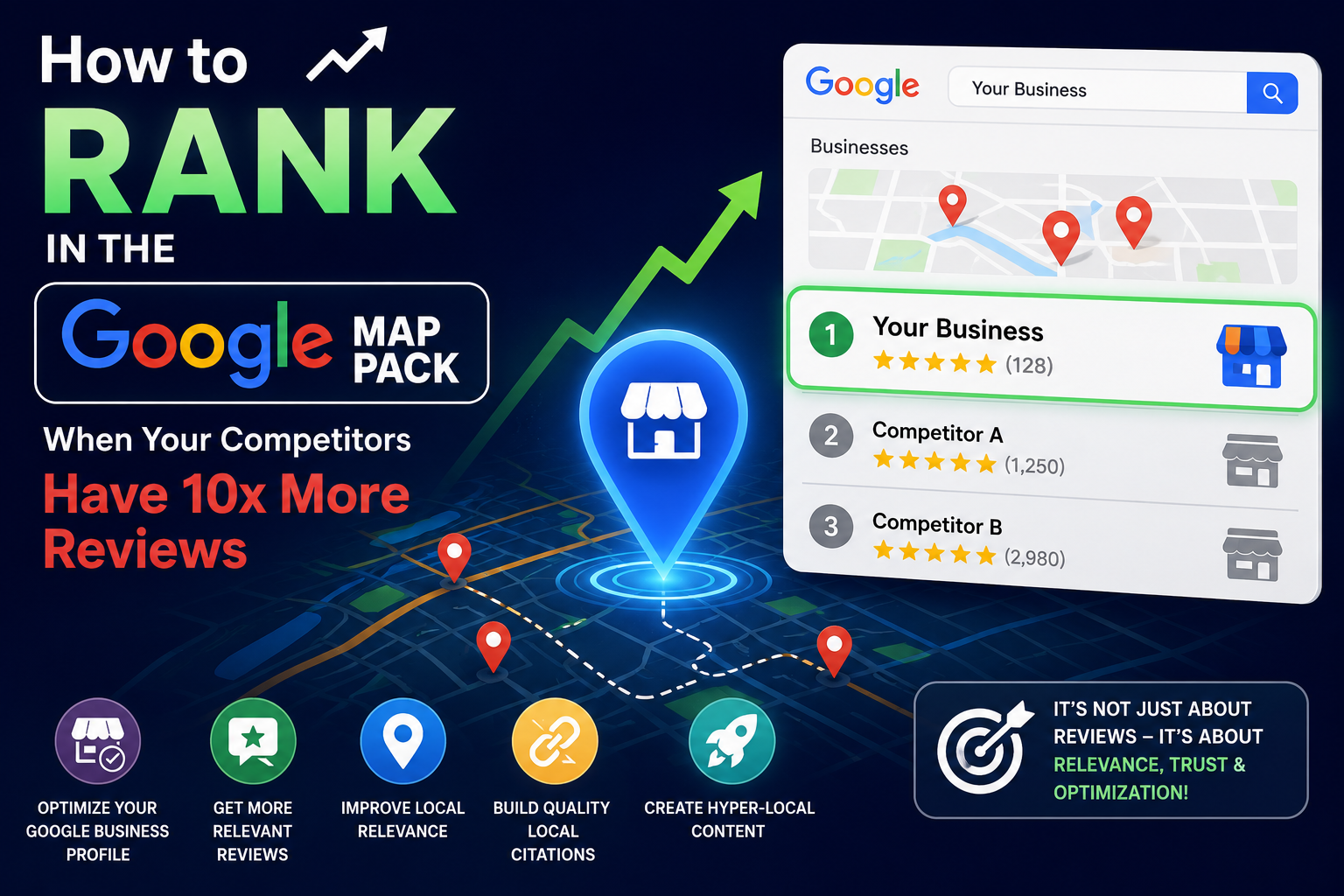
If you own a local business, you’ve probably searched for your services on Google and noticed competitors dominating the Google Map Pack with hundreds or even thousands of reviews. Seeing your business with only a handful of reviews can make it seem impossible to compete.
The good news is that review count is only one of many ranking factors. While reviews influence local search visibility, Google evaluates a much broader set of signals before deciding which businesses appear in the Map Pack.
Many businesses with fewer reviews consistently outrank competitors because they optimise other important ranking factors more effectively.
This guide explains how the Google Map Pack works and the strategies that can help your business compete, even when competitors have significantly more reviews.
What Is the Google Map Pack?
The Google Map Pack, sometimes called the Local Pack, is the group of local business listings that appears near the top of Google search results for location based searches.
Examples include:
- Dentist near me
- Digital marketing agency in Mumbai
- Coffee shop in Bengaluru
- Car repair in Chennai
- Family lawyer in Delhi
The Map Pack usually displays:
- Business name
- Star rating
- Number of reviews
- Address
- Opening hours
- Phone number
- Website
- Directions
Appearing here can generate more calls, website visits, and customer enquiries.
Does Google Rank Businesses by Review Count Alone?
No.
Google has publicly stated that local rankings are primarily influenced by three major factors:
- Relevance
- Distance
- Prominence
Reviews contribute to prominence, but they are only one part of the overall picture.
A business with fewer reviews can still rank above competitors if it is more relevant to the search and has stronger local optimisation.
Optimise Your Google Business Profile
Your Google Business Profile is one of the most important local ranking signals.
Ensure every section is complete.
Include:
- Correct business name
- Primary category
- Secondary categories
- Phone number
- Website
- Business hours
- Business description
- Service areas
- Products
- Services
- Appointment links
A complete profile helps Google better understand your business.
Choose the Right Business Categories
Selecting the correct primary category is critical.
For example, if you are a career counselling company, choosing “Career Guidance Service” or another relevant category is usually more effective than selecting a broad category that doesn’t accurately describe your business.
Secondary categories should support your main services without being unrelated.
Write a Keyword Focused Business Description
Your description should clearly explain:
- What you do
- Who you help
- Where you operate
- Your main services
- Your expertise
Keep the writing natural and avoid keyword stuffing.
Add High Quality Photos Regularly
Businesses with active profiles often appear more trustworthy.
Upload:
- Office photos
- Team photos
- Interior images
- Exterior images
- Product photos
- Before and after examples where appropriate
Fresh images demonstrate that your business is active.
Publish Google Posts
Regular Google Posts show ongoing activity.
You can publish updates about:
- New services
- Blog articles
- Offers
- Events
- Success stories
- Company news
Posting consistently can improve customer engagement.
Get Better Reviews Instead of More Reviews
Having 50 genuine, detailed reviews is often more valuable than hundreds of short, generic reviews.
Encourage customers to mention:
- The service they received
- Their experience
- The location
- Specific results
- Staff members who helped them
Detailed reviews provide richer information for both users and search engines.
Respond to Every Review
Reply to:
- Positive reviews
- Neutral reviews
- Negative reviews
Professional responses demonstrate customer engagement and show potential customers that you value feedback.
Optimise Your Website for Local SEO
Your website supports your Google Business Profile.
Include:
- Local landing pages
- Service pages
- Contact information
- Embedded Google Map
- Local keywords
- Clear calls to action
Google uses website content to understand business relevance.
Create Individual Service Pages
Instead of placing every service on one page, create dedicated pages.
Examples include:
- Career Counselling
- Study Abroad Guidance
- Psychometric Assessment
- DMIT Testing
- Education Counselling
Each page should provide detailed information about the specific service.
Build Local Citations
Local citations are mentions of your business across trusted websites.
Ensure your:
- Business name
- Address
- Phone number
remain consistent everywhere.
Common citation sources include:
- Business directories
- Local chambers of commerce
- Industry directories
- Professional associations
Consistency helps build trust.
Earn High Quality Local Backlinks
Backlinks remain an important ranking factor.
Focus on earning links from:
- Local news websites
- Community organisations
- Educational institutions
- Industry associations
- Local business directories
Quality matters far more than quantity.
Improve Website Speed
A slow website creates a poor user experience.
Improve performance by:
- Compressing images
- Using fast hosting
- Minimising unnecessary scripts
- Enabling browser caching
- Optimising mobile performance
Faster websites encourage visitors to stay longer.
Make Your Website Mobile Friendly
Most local searches happen on mobile devices.
Your website should:
- Load quickly
- Display correctly on small screens
- Use readable text
- Offer simple navigation
- Make contact buttons easy to find
A mobile friendly website improves both usability and search performance.
Create Helpful Local Content
Publishing useful content builds topical authority.
Examples include:
- Local guides
- Frequently asked questions
- Community news
- Educational articles
- Customer success stories
Content that answers local search intent helps strengthen relevance.
Use Local Keywords Naturally
Include location specific phrases where appropriate.
For example:
- Career counsellor in Hyderabad
- Study abroad consultant in Pune
- Education counselling in Bengaluru
Avoid repeating keywords unnaturally.
Add Local Business Schema
Structured data helps search engines understand your website.
Schema can include:
- Business information
- Address
- Opening hours
- Reviews
- Services
- Contact details
Although schema alone does not guarantee rankings, it improves search engine understanding.
Build Brand Authority
Google increasingly values recognised businesses.
You can strengthen authority by:
- Publishing expert content
- Appearing in local media
- Speaking at community events
- Partnering with organisations
- Earning mentions on reputable websites
A stronger brand often attracts more searches and engagement.
Increase Branded Searches
When more people search specifically for your business, Google receives stronger brand signals.
Build awareness through:
- Social media
- Email marketing
- Community involvement
- Educational webinars
- Local partnerships
Strong brands often perform better in local search.
Improve User Engagement
Businesses that satisfy users often perform better over time.
Encourage visitors to:
- Visit your website
- Call your business
- Request directions
- Book appointments
- Read your content
Providing an excellent customer experience can lead to stronger engagement signals.
Keep Business Information Consistent
Your business name, address, and phone number should be identical across:
- Your website
- Google Business Profile
- Business directories
- Social media profiles
- Industry listings
Inconsistent information can reduce trust.
Focus on Long Tail Local Searches
Highly competitive keywords are difficult to rank for initially.
Instead, target more specific searches.
Examples include:
- Career counselling for Class 12 students in Jaipur
- Study abroad consultant for Canada in Ahmedabad
- Psychometric assessment for students in Kochi
These searches often have lower competition and higher conversion rates.
Monitor Your Local Performance
Track important metrics such as:
- Map Pack visibility
- Website traffic
- Phone calls
- Direction requests
- Customer enquiries
- Keyword rankings
- Review growth
Regular monitoring helps identify opportunities for improvement.
Avoid Common Mistakes
Some businesses unknowingly hurt their local rankings.
Avoid:
- Buying fake reviews
- Keyword stuffing your business name
- Using inconsistent contact information
- Ignoring negative reviews
- Creating duplicate business listings
- Neglecting website updates
Following Google’s guidelines helps reduce the risk of ranking issues.
How Long Does It Take to Improve Map Pack Rankings?
Local SEO is a long term strategy.
Some businesses notice improvements within a few months, while highly competitive markets may take longer.
The timeline depends on factors such as:
- Competition
- Website quality
- Business profile optimisation
- Local authority
- Review growth
- Content quality
Consistency is more important than quick wins.
Conclusion
Competing against businesses with ten times more reviews can feel discouraging, but review count alone does not determine Google Map Pack rankings. Google evaluates many signals, including relevance, distance, prominence, website quality, business profile optimisation, local authority, and user experience.
By maintaining a complete Google Business Profile, publishing valuable local content, earning quality backlinks, improving your website, collecting authentic reviews, and providing excellent customer service, you can strengthen your local search presence over time.
Success in local SEO comes from building trust with both customers and search engines. Businesses that focus on long term optimisation rather than shortcuts are more likely to achieve sustainable visibility in the Google Map Pack.
Frequently Asked Questions
Can I rank in the Google Map Pack with fewer reviews?
Yes. Review count is only one ranking factor. A well optimised Google Business Profile, relevant website content, strong local SEO, and positive customer engagement can help businesses rank even with fewer reviews.
Are reviews important for local SEO?
Yes. Reviews contribute to local prominence and influence customer trust, but Google also considers relevance, distance, and many other ranking signals.
How many Google reviews do I need to rank?
There is no fixed number. The quality, recency, and relevance of reviews often matter more than simply having the highest count.
Should I buy Google reviews?
No. Buying fake reviews violates Google’s policies and can result in review removal or reduced visibility.
Does responding to reviews help rankings?
Responding to reviews demonstrates that your business values customer feedback. While it is not a direct ranking guarantee, it supports customer engagement and trust.
What is the most important Google Business Profile ranking factor?
Google highlights relevance, distance, and prominence as the primary local ranking factors. A complete and accurate business profile supports all three.
Can local backlinks improve Map Pack rankings?
Quality local backlinks strengthen your website’s authority and can support your overall local SEO strategy.
How often should I update my Google Business Profile?
Regular updates are recommended. Add new photos, publish Google Posts, update business information when needed, and respond promptly to customer reviews.
Why is my competitor ranking above me with fewer reviews?
They may have a more relevant business category, stronger website, better local content, higher quality backlinks, closer proximity to the searcher, or a more complete Google Business Profile.
How long does local SEO take to show results?
Results vary depending on competition and the current state of your online presence. Consistent optimisation over several months is often required to achieve lasting improvements.