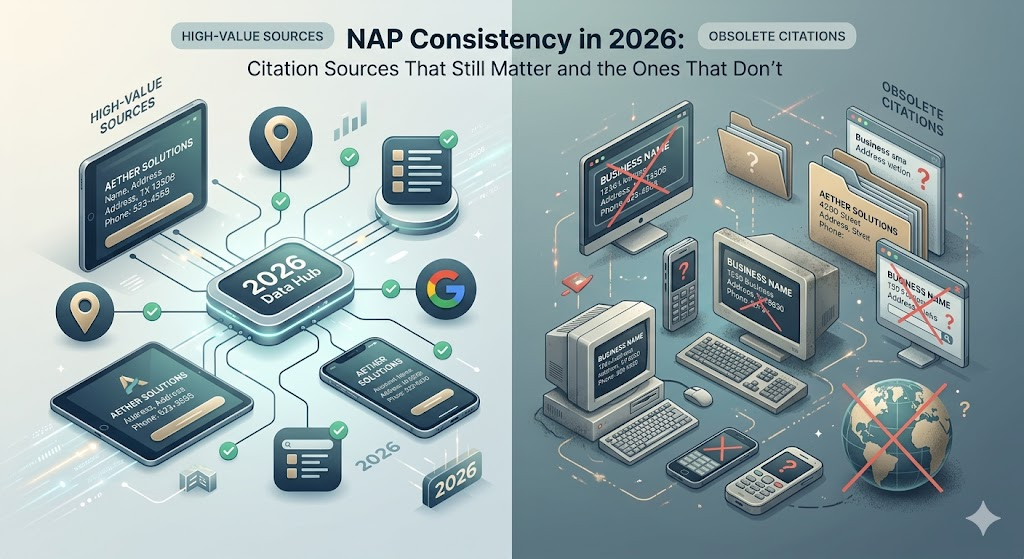
As local search algorithms become more advanced, maintaining consistent NAP data across digital platforms is still important for local visibility. NAP stands for Name, Address, and Phone Number. These details help search engines confirm that a business is real, active, and located where it claims to be.
In 2026, citation quality matters more than citation quantity. Search engines are no longer impressed by hundreds of low-quality directory listings. Instead, they look for accurate business information on trusted platforms such as Google Business Profile, Apple Maps, Yelp, Bing Places, Facebook, and other reliable sources.
When your NAP details are consistent, search engines can connect all mentions of your business to one verified entity. When your information is inconsistent, search engines may lose confidence in your business profile, which can affect your local rankings.
Understanding NAP Consistency in 2026
NAP consistency means your business name, address, and phone number appear exactly the same across all important online platforms. Even small differences can create confusion.
For example, using “Street” on one platform and “St.” on another may seem minor, but repeated inconsistencies across many directories can weaken your local signals. The same applies to business names, suite numbers, phone numbers, and website URLs.
Search engines use this information to confirm your business identity. If the same details appear across trusted sources, your business looks more reliable. If the information is mixed, outdated, or duplicated, it becomes harder for search engines to understand which listing is correct.
NAP Data Elements That Need Exact Matching
| NAP Element | What Should Stay Consistent | Common Mistake |
|---|---|---|
| Business Name | Use the same official business name everywhere | Adding LLC, Inc., keywords, or location terms on some platforms |
| Address | Keep street name, suite number, city, and ZIP code identical | Using different abbreviations or missing suite numbers |
| Phone Number | Use one primary business phone number across platforms | Using different tracking numbers without proper setup |
| Website URL | Use the same main website URL | Mixing homepage, landing page, or redirected URLs |
| Business Category | Keep categories aligned with your main service | Choosing unrelated or inconsistent categories |
How Inconsistent NAP Data Affects Local Rankings
Inconsistent NAP data can reduce trust. When search engines find different versions of your business information, they may assign lower confidence to your listings. This can affect your visibility in Google Maps, local pack results, and location-based searches.
Duplicate listings are another common problem. If one directory has an old address and another has a new address, data providers may create separate listings for the same business. This splits your local signals and makes it harder for search engines to connect everything to one business entity.
Inaccurate citations can also confuse customers. If someone finds an old phone number or wrong address, they may lose trust or choose a competitor instead.
Google’s Evolving Citation Standards
Google’s local search systems now focus more on citation quality, entity alignment, and data accuracy. This means a few trusted and accurate listings are more valuable than hundreds of weak directory submissions.
Older citation strategies often focused on bulk submissions. Businesses would list themselves on as many directories as possible, even if those sites had low authority or poor data quality. That approach is less useful today.
In 2026, businesses should focus on platforms that have strong verification systems, real users, and reliable data updates. These sources help search engines confirm business information more confidently.
Citation Sources That Still Matter in 2026
| Citation Source | Why It Still Matters | Priority Level |
|---|---|---|
| Google Business Profile | Strongest local visibility source for Google Maps and local pack results | Very High |
| Apple Maps | Important for iPhone users and local mobile searches | High |
| Bing Places | Supports visibility across Bing and Microsoft search experiences | High |
| Yelp | Useful for reviews, trust signals, and service-based searches | High |
| Facebook Business Page | Helps with brand verification and local discovery | Medium to High |
| Better Business Bureau | Adds trust and credibility for many service businesses | Medium |
| Chamber of Commerce | Useful for local authority and business validation | Medium |
| Industry Directories | Valuable when relevant to your niche or profession | Medium to High |
| Nextdoor | Helpful for neighborhood-based businesses | Medium |
| Angi or HomeAdvisor | Useful for home service businesses | Medium |
Google Business Profile
Google Business Profile remains the most important citation source for local SEO. It directly affects how your business appears in Google Maps, local pack results, branded searches, and nearby searches.
Your profile should include accurate NAP details, business hours, categories, services, photos, reviews, and regular updates. If your Google Business Profile has incorrect or incomplete information, it can weaken your local visibility.
Businesses should also avoid duplicate profiles. Multiple listings for the same location can confuse both users and search engines.
Apple Maps, Yelp, and Bing Places
Apple Maps continues to matter because many users search through iPhones, Siri, and Apple Maps. If your business information is missing or incorrect there, you may lose mobile search visibility.
Yelp is still relevant for many service-based and local businesses. It supports reputation, reviews, and discovery. Even when users do not contact you directly through Yelp, search engines may still use Yelp data as a supporting trust signal.
Bing Places is also important because it supports Microsoft search visibility. While Google receives more search activity, Bing still contributes to local discovery, especially across desktop and Microsoft products.
Citation Sources Losing Relevance
Not all citation sources are worth your time in 2026. Many older directories have lost influence because they have poor verification, outdated data, low traffic, or spam-heavy listings.
Businesses should avoid spending too much effort on low-quality directories that do not help users or search engines. These platforms can sometimes create more harm than value if they publish outdated or duplicate information.
Citation Sources to Deprioritize
| Source Type | Why It Matters Less Now | What To Do Instead |
|---|---|---|
| Old general directories | Many have low authority and outdated data | Focus on trusted platforms |
| Bulk submission networks | Can create duplicate or inaccurate listings | Use manual or verified submissions |
| Spam-heavy directories | May weaken citation quality | Avoid or remove incorrect listings |
| Irrelevant niche directories | Do not support your business category | Choose industry-relevant sources |
| Unverified listing sites | Can publish wrong information easily | Prioritize verified profiles |
Strategic Citation Management
Citation management should be treated as an ongoing process, not a one-time task. Business details can change, platforms can update their systems, and duplicate listings can appear over time.
Start by creating a master NAP document. This should include your official business name, address, phone number, website URL, business description, categories, hours, and social links. Every listing should be updated based on this document.
Next, audit your most important citation sources. Check Google Business Profile, Apple Maps, Bing Places, Yelp, Facebook, and major industry directories first. Correct any errors before moving to secondary platforms.
A quarterly audit is a good practice for most businesses. This helps catch new errors, outdated information, and duplicate listings before they affect local search performance.
Citation Management Workflow
| Step | Action | Purpose |
|---|---|---|
| 1 | Create a master NAP document | Keeps all business information consistent |
| 2 | Audit major platforms | Finds incorrect or outdated listings |
| 3 | Fix high-priority citations first | Strengthens local search signals quickly |
| 4 | Remove or merge duplicate listings | Prevents confusion and split authority |
| 5 | Update secondary directories | Improves broader consistency |
| 6 | Monitor changes quarterly | Maintains accuracy over time |
Monitoring and Maintenance Tools
Citation management tools can help businesses monitor listings, detect inconsistencies, and update information across multiple platforms. These tools are especially useful for businesses with multiple locations.
| Tool | Best For | Key Use |
|---|---|---|
| BrightLocal | Small and medium businesses | Citation audits, local rank tracking, reporting |
| Moz Local | Businesses needing listing distribution | Data distribution and error detection |
| Semrush Local | SEO teams using Semrush | Citation monitoring and local SEO tracking |
| Yext | Multi-location and enterprise businesses | Large-scale listing management |
| Synup | Franchise and chain businesses | Multi-location visibility and citation management |
These tools can save time, but they should not replace manual review completely. Important listings should still be checked directly to make sure the information appears correctly.
Future-Proofing Your NAP Data
The future of local SEO is moving toward entity-based understanding. Search engines want to know that all online mentions of your business point to the same real-world entity.
To prepare for this, businesses should maintain one source of truth for their NAP data, use LocalBusiness schema on their website, monitor brand mentions, align business categories, and review citations regularly.
Structured data can also help. Adding LocalBusiness schema to your homepage gives search engines a clearer technical signal about your business name, address, phone number, location, and services.
Best Practices for NAP Consistency in 2026
Keep your official business name the same everywhere. Do not add keywords to your business name unless they are part of the legal or official brand name.
Use one primary phone number across major platforms. If you use call tracking, make sure it is implemented properly so it does not create citation confusion.
Keep your address formatting consistent. Suite numbers, building names, postal codes, and city names should match across listings.
Update your Google Business Profile first when any business detail changes. Then update Apple Maps, Bing Places, Yelp, Facebook, and other important sources.
Avoid mass submissions to low-quality directories. Focus on trusted, relevant, and verified citation sources.
Frequently Asked Questions
What is NAP consistency?
NAP consistency means your business name, address, and phone number appear the same across online platforms. It helps search engines confirm your business identity and location.
Why does NAP consistency still matter in 2026?
NAP consistency still matters because search engines use accurate business information to verify local entities. Consistent data helps improve trust, local visibility, and map rankings.
Which citation sources matter most in 2026?
The most important citation sources include Google Business Profile, Apple Maps, Bing Places, Yelp, Facebook, and relevant industry directories.
Are old directories still useful for local SEO?
Some older directories may still have value, but many low-quality or outdated directories are no longer worth prioritizing. Businesses should focus on trusted and relevant platforms.
How often should businesses audit citations?
Most businesses should audit citations at least once every quarter. Businesses with multiple locations or frequent changes may need monthly checks.
Can inconsistent NAP hurt local rankings?
Yes. Inconsistent NAP can reduce search engine trust, create duplicate listings, and weaken local visibility.
Should I use citation management tools?
Citation management tools can be helpful, especially for businesses with many listings or multiple locations. However, important listings should still be reviewed manually.
What should I do if I find duplicate listings?
You should claim, merge, or remove duplicate listings where possible. Duplicate listings can split local authority and confuse search engines.
Does schema markup help with NAP consistency?
Yes. LocalBusiness schema helps search engines understand your business details more clearly and supports entity recognition.
What is the best way to maintain NAP consistency?
The best approach is to keep one master NAP document, update major platforms first, monitor citations regularly, and avoid low-quality directory submissions.